Introduction
Large electricity consumers in Tamil Nadu are increasingly looking beyond TANGEDCO for power supply. Third-party power purchase under open access is the regulatory mechanism that makes this possible — but the process is governed by specific rules that are frequently misunderstood.
Many C&I consumers underestimate the complexity. They see PPA tariffs in the ₹3.20–4.50/kWh range versus TANGEDCO's HT industrial tariff of ₹7.50/kWh and assume the savings are straightforward. But cross-subsidy surcharges, volatile additional surcharges, wheeling fees, and strict scheduling penalties can erode those margins dramatically.
What follows is a practical breakdown of how the TNEB/TANGEDCO third-party purchase framework actually works — eligibility, applicable charges, PPA structure, and compliance requirements — for C&I consumers, renewable developers, and energy managers navigating this space.
Key Takeaways
- TPP lets eligible C&I consumers buy power directly from an independent generator via TANGEDCO's open access grid
- Governed by Electricity Act 2003 (Sections 9 & 42) and TNERC Open Access Regulations, 2014
- Landed cost includes wheeling (₹1.04/kWh), cross-subsidy surcharge (₹1.99/kWh for HT-IA), and additional surcharge on top of PPA tariff
- Additional surcharge (currently ₹0.10/kWh for Apr–Sep 2025) is revised biannually and has ranged from zero to ₹0.54/kWh since 2023
- Generators under existing long-term sale-to-TANGEDCO agreements face migration restrictions
What Is TNEB Third-Party Power Purchase?
TNEB third-party power purchase is a contractual arrangement where an independent power producer (IPP) sells electricity directly to a commercial or industrial (C&I) consumer through TANGEDCO's grid under open access. The IPP — typically a solar or wind generator — bypasses TANGEDCO as the default off-taker, supplying power under a bilateral agreement instead.
Legal Foundation
Section 42(2) of the Electricity Act, 2003 grants eligible consumers the right to open access for purchase from generators. TNERC's Grid Connectivity and Intra-State Open Access Regulations, 2014 put this right into practice in Tamil Nadu. The State Load Despatch Centre (SLDC) manages scheduling and metering under this framework, with all power flows tracked in 15-minute time blocks.
How TPP Differs from Other Models
Third-party purchase sits between two closely related procurement models:
- Captive generation: Consumer co-owns the generating asset, with distinct ownership structures and RPO treatment
- Power exchange purchase: Short-term market trading sourced from day-ahead or real-time markets, with no bilateral PPA
TPP occupies the middle ground: bilateral, long-term, with a dedicated PPA between the generator and consumer, but without ownership or equity participation.
Why C&I Businesses in Tamil Nadu Use Third-Party Power Purchase
Cost Savings Versus TANGEDCO Tariffs
HT industrial consumers in Tamil Nadu face TANGEDCO tariffs of ₹7.50/kWh for FY 2025-26, with HT-III commercial consumers paying ₹9.40/kWh. Third-party solar or wind PPAs are typically signed in the ₹3.20–4.50/kWh range, creating a significant per-unit saving margin even after accounting for open access charges.
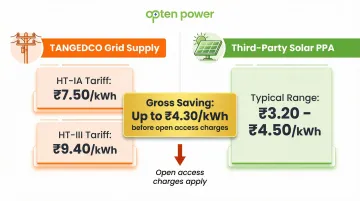
The landed cost calculation is what determines actual savings. After stacking all open access charges, the margin narrows — but typically remains favourable:
- Wheeling charges: ₹1.04/kWh
- Cross-subsidy surcharge: ₹1.99/kWh (HT-IA consumers)
- Additional surcharge: ₹0.10/kWh (Apr–Sep 2025)
- Transmission charges and electricity duty apply on top
Net savings depend on the consumer category and contracted PPA rate, but most HT consumers still land well below TANGEDCO tariffs.
Tariff Certainty and Hedge Against Escalation
TANGEDCO tariffs are revised periodically and have trended upward over time. For FY 2025-26, TNERC applied a 3.16% CPI-linked escalation. A long-term TPP agreement with a fixed or low-escalation tariff clause gives industries a predictable energy cost baseline, insulating them from future tariff shocks.
Renewable Purchase Obligation (RPO) Compliance
C&I consumers above a certain threshold have RPO obligations under Tamil Nadu's policy. TNERC's 2025 amendment mandates a total RPO of 33.01% for FY 2025-26, up from 29.91% the prior year. Procuring power via a renewable energy TPP directly contributes to meeting these targets, reducing the need to purchase Renewable Energy Certificates (RECs) separately.
The 33.01% target breaks down across source categories:
- Solar and other RE: 28.24%
- Distributed RE: 2.10%
- Hydro: 1.22%
- Wind: 1.45%
ESG and Sustainability Commitments
Sectors like IT parks, data centres, and export-oriented manufacturing increasingly face international pressure to demonstrate clean energy procurement. A third-party renewable PPA provides documented, traceable renewable energy consumption that satisfies Scope 2 reporting requirements and supports alignment with frameworks like RE100 — increasingly a baseline expectation for global supply chain partners.
How Third-Party Power Purchase Works Under TNERC Regulations
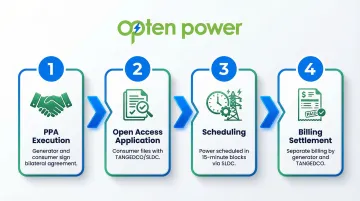
The end-to-end process follows a defined sequence across three stages:
- Generator and consumer negotiate and execute a Power Purchase Agreement
- Consumer applies for open access to TANGEDCO/SLDC
- Power is scheduled in 15-minute blocks; TANGEDCO wheels it for applicable charges
- Monthly billing is settled separately between generator, consumer, and TANGEDCO
Step 1: Eligibility Assessment and PPA Execution
Consumers must meet minimum contracted demand thresholds. Historically, the standard threshold for intra-state open access was 1 MW. However, the TNERC Green Energy Open Access Regulations 2025 lower this threshold to 63 kVA for EHT and HT consumers procuring green energy.
The generator and consumer negotiate a Power Purchase Agreement specifying:
- Tariff (₹/kWh)
- Contract duration (commonly 10 or 25 years)
- Escalation clause (fixed, CPI-linked, or nil)
- Minimum off-take obligations
For C&I consumers managing multiple bids, tools like Opten Power's Automated Tender Engine speed up this stage considerably. The platform lets buyers issue RFPs using modular templates, collect structured bids from multiple developers, and work from pre-approved contract frameworks — cutting the time from vendor search to PPA execution by up to 50%.
Step 2: Open Access Application to SLDC and TANGEDCO
The consumer or generator files an application with the Tamil Nadu SLDC and TANGEDCO for open access connectivity. The application covers technical details including injection and drawal points, contracted capacity, and scheduling intent.
TNERC regulations stipulate timelines within which TANGEDCO must respond:
| Open Access Type | Duration | Nodal Agency | Processing Timeline |
|---|---|---|---|
| Short-Term (STOA) | Up to 1 month | SLDC | 7 days (first time), 3 days (subsequent) |
| Medium-Term (MTOA) | 3 months to 3 years | STU (TANTRANSCO) | 20 to 40 days |
| Long-Term (LTOA) | 12 to 25 years | STU (TANTRANSCO) | 120 to 150 days |
In practice, these timelines are often exceeded. Industry reports point to poor synchronisation between SLDCs and DISCOMs as a consistent source of portal delays — something consumers should factor into project timelines before scheduling power delivery.
Step 3: Scheduling, Wheeling, and Billing
Once open access is granted, the generator submits generation schedules to SLDC in 15-minute blocks. Deviation from schedule attracts penalties under the Deviation Settlement Mechanism (DSM). TANGEDCO meters power at the injection and drawal points.
The consumer is billed:
- By the generator at the PPA tariff
- Separately by TANGEDCO for all applicable open access charges
Accurate forecasting is critical. Solar and wind generators face inherent variability, making accurate scheduling challenging and affecting the practical viability of open access for certain generator profiles.
Charges and Levies Under Third-Party Open Access in Tamil Nadu
The total landed cost of third-party power includes multiple regulatory charges stacked on top of the PPA tariff. Net savings over TANGEDCO tariff can vary significantly depending on the charge structure in force at any given time.
Wheeling Charges and Transmission Charges
Wheeling charges compensate TANGEDCO for use of its distribution network and are set at ₹1.04/kWh for HT consumers in FY 2025-26. Transmission charges apply if power flows through the State Transmission Utility or PGCIL network, set at ₹241.81/MW/hr for STOA.
Cross-Subsidy Surcharge (CSS)
Beyond transmission costs, open access consumers pay a Cross-Subsidy Surcharge under Section 42(2) of the Electricity Act. This compensates TANGEDCO for subsidies it provides to other consumer categories, and the rate varies by category and voltage level:
- HT-IA (Industry): ₹1.99/kWh
- HT-III (Commercial): ₹2.57/kWh
This is one of the larger fixed cost components of open access and is revised during tariff orders.
Additional Surcharge under Section 42(4)
On top of CSS, third-party sale and power exchange consumers pay an Additional Surcharge under Section 42(4) to cover fixed costs of stranded power purchase commitments of TANGEDCO/TNPDCL. This charge has been highly volatile:
- April–September 2023: Fully exempted
- Early 2024: ₹0.34/kWh
- December 2024: Revised to ₹0.54/kWh
- April–September 2025: Reduced to ₹0.10/kWh
TNERC mandates fresh petitions and data submissions every six months, so consumers must monitor this charge actively.
Other Levies
Additional costs include:
- Electricity duty: 5% on consumption charge (state government levy)
- SLDC scheduling charge: ₹209/day/transaction
- System operation charge: ₹96.16/MW/day
- Banking charges (if the consumer opts to bank surplus power with TANGEDCO for later use)
In aggregate, these levies typically add ₹1.50–2.00/kWh to the cost of open access power — enough to erase most of the savings if not accounted for upfront.
Sample Landed Cost Breakdown
| Component | HT-IA Industrial Consumer (₹/kWh) |
|---|---|
| PPA Tariff (Solar) | 3.80 |
| Wheeling Charge | 1.04 |
| Cross-Subsidy Surcharge | 1.99 |
| Additional Surcharge (Apr-Sep 2025) | 0.10 |
| Electricity Duty (5%) | 0.19 |
| SLDC & System Charges (estimated) | 0.05 |
| Total Landed Cost | 7.17 |
| TANGEDCO HT-IA Tariff | 7.50 |
| Net Saving | 0.33 |
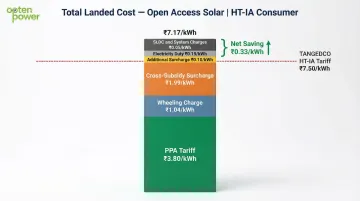
With a PPA tariff of ₹3.80/kWh and a net saving of just ₹0.33/kWh, the regulatory charge stack consumes roughly 91% of the gross benefit. Any shift in CSS or Additional Surcharge rates directly moves that net saving figure — which is why tracking TNERC tariff orders matters as much as negotiating the PPA rate itself.
Key Regulatory Factors and Compliance Requirements
TNERC Open Access Regulations, 2014 as the Primary Framework
All intra-state open access transactions — long-term, medium-term, and short-term — are governed by the TNERC Grid Connectivity and Intra-State Open Access Regulations, 2014. These regulations define eligible consumers, application procedures, timelines, banking provisions, and scheduling rules. Consumers and generators must stay current with TNERC amendment orders as the regulations have been revised over time.
Migration Restrictions for Existing Generators
A significant regulatory constraint was revealed by TANGEDCO's December 2022 board decision — generators holding long-term energy purchase agreements (sale-to-TANGEDCO) are not permitted to migrate to third-party sale or captive use. TANGEDCO has cited rising RPO obligations and the absence of payment grievances as grounds to deny migration.
The Madras High Court has repeatedly intervened, setting aside such circulars and directing TANGEDCO to permit migration and settle dues. The legal position remains contested, and developers considering new projects should structure agreements carefully from the start to preserve third-party sale rights.
Forecasting and Deviation Penalties under DSM
TNERC's 2024 Forecasting, Scheduling and Deviation Settlement Mechanism Regulations require generators to forecast generation accurately in 15-minute blocks. Significant deviations attract financial penalties:
| Absolute Error (%) | Solar Deviation Charge | Wind Deviation Charge |
|---|---|---|
| ≤10% | Nil | Nil (up to 15% for Wind) |
| >10% to ≤20% | ₹0.25/unit | ₹0.25/unit (applies >15%) |
| >20% to ≤30% | Base + ₹0.50/unit for excess | Base + ₹0.50/unit for excess |
| >30% | Base + ₹1.25/unit for excess | Base + ₹1.25/unit for excess |
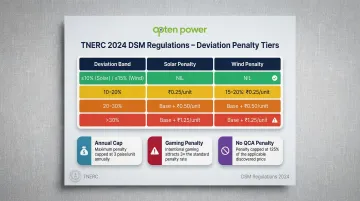
Three additional penalty conditions apply beyond the table above:
- Annual cap: Total deviation charges are capped at 3 paise/unit × total annual generation
- Gaming penalty: Intentional mis-declaration attracts 3× the standard deviation charges
- No QCA penalty: Operating without a Qualified Co-ordinating Agency (QCA) results in a 125% capped price penalty
Common Issues, Misconceptions, and When TPP May Not Be Appropriate
Common Misconception — TPP Always Saves Money
Many C&I consumers evaluate only the PPA tariff versus the TANGEDCO tariff without modelling all open access charges. After adding CSS, additional surcharge, wheeling, and transmission charges, actual savings often fall well short of initial estimates.
The additional surcharge alone jumped from exemption to ₹0.54/kWh within roughly 18 months — that kind of volatility can erase projected savings quickly. Calculate your true landed cost before committing:
- Start with the PPA tariff (₹/kWh)
- Add wheeling charge (₹1.04/kWh)
- Add cross-subsidy surcharge (₹1.99/kWh for HT-IA)
- Add current additional surcharge (check TNERC's latest order)
- Add transmission charges (if applicable)
- Add electricity duty (5% of total consumption charge)
- Add SLDC scheduling and system operation charges
Compare this total landed cost to your current TANGEDCO tariff before committing.
When TPP May Not Be Appropriate
Third-party power purchase is not suitable for:
- Contracted demand below 63 kVA — bilateral TPP is inaccessible; rooftop solar PPAs or regulatory changes are the only viable paths
- Highly variable or unpredictable load profiles — scheduling obligations and DSM penalties can be difficult to manage consistently
- Short-term arrangements for smaller C&I consumers — open access compliance (applications, scheduling, bilateral contracts) often outweighs savings; group captive or power exchange purchases are simpler alternatives
Where Generators Face Restrictions
Renewable energy generators locked into long-term sale-to-TANGEDCO agreements cannot freely shift to the TPP model. TANGEDCO's migration restrictions remain a practical barrier despite ongoing legal challenges. For developers structuring new projects, building in contract flexibility from the outset — including exit clauses and third-party sale rights — is far easier than negotiating it later.
Frequently Asked Questions
What is a TNEB third-party solar power purchase agreement (PPA) and what do 10-year and 25-year PPAs mean?
A TNEB third-party solar PPA is a bilateral contract between a solar IPP and a C&I consumer under Tamil Nadu's open access framework, where the consumer buys solar power directly at a negotiated tariff. A 10-year PPA suits shorter commitments at potentially higher rates; a 25-year PPA locks in pricing certainty and is standard for utility-scale ground-mounted projects.
What charges does a third-party open access consumer pay in Tamil Nadu besides the PPA tariff?
Open access consumers pay wheeling charges (₹1.04/kWh), transmission charges, cross-subsidy surcharge (₹1.99/kWh for HT-IA industry), additional surcharge (₹0.10/kWh for Apr-Sep 2025), electricity duty (5% of consumption charge), and SLDC scheduling charges. Together, these levies add ₹1.50–2.00/kWh or more to the PPA tariff to arrive at the total landed cost of open access power.
What is the minimum contracted demand required to avail open access in Tamil Nadu?
Under TNERC's traditional intra-state regulations, the minimum threshold was 1 MW. The Green Energy Open Access Regulations 2025 lower this to 63 kVA for EHT and HT consumers procuring green energy — consumers below this must explore rooftop solar or group captive models instead.
What is the additional surcharge under Section 42(4) and how is it determined by TNERC?
The additional surcharge under Section 42(4) of the Electricity Act, 2003 compensates TANGEDCO/TNPDCL for stranded power purchase commitments. TNERC revises it every six months based on stranded capacity data — rates have ranged from full exemption (April–September 2023) to ₹0.54/kWh (December 2024–March 2025), with the current rate at ₹0.10/kWh for April–September 2025.