Introduction
Commercial and industrial (C&I) businesses in Rajasthan face mounting pressure from rising electricity costs. Large industrial consumers currently pay ₹6.50/kWh in energy charges plus ₹380/kVA/month in fixed demand charges under the HT-5 tariff category—costs that compound with regulatory surcharges and fuel price adjustment charges. Grid dependency exposes businesses to tariff volatility and supply uncertainties that directly erode operational budgets and competitiveness.
Solar Power Purchase Agreements (PPAs) offer a zero-capital solution to this challenge. Under a PPA, a developer finances, builds, and operates a solar plant while the business pays only for the electricity consumed at a pre-agreed tariff—typically 20-40% below DISCOM rates—locked in for 15-25 years.
Rajasthan's position as India's solar leader makes it the strongest environment for C&I solar PPAs. The state receives solar irradiation of 5.5 to 6.0 kWh/m²/day—among the highest in the country—and holds 38.7 GW of installed solar capacity as of February 2026, more than any other Indian state.
The recent 810 MW NIRL-RVUNL deal at Pugal Solar Park at ₹2.64/kWh confirms the state's competitive tariff environment—and the real savings available to C&I buyers who move now.
This guide walks through how solar PPAs work in Rajasthan, what the RERC (Rajasthan Electricity Regulatory Commission) framework means for your project, how to calculate your savings potential, and what to expect at each step of signing a deal.
Key Takeaways
- Solar PPAs give businesses solar power at zero upfront cost — pay only for units consumed at a fixed tariff
- Rajasthan's high solar irradiation and RERC's Green Energy Open Access rules make it among India's most cost-effective states for C&I solar PPAs
- PPA tariffs are locked in for 15-25 years, shielding businesses from DISCOM tariff escalations and providing long-term energy cost certainty
- Pick from on-site, offsite open access, or group captive structures to match your load profile
- Navigate RERC open access approvals, wheeling charges, and banking provisions to maximise net savings
How a Solar PPA Works for C&I Businesses
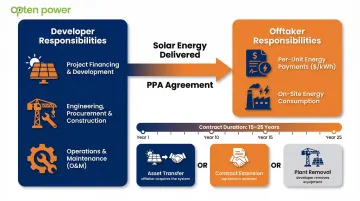
A solar PPA is a long-term contract between a solar developer (seller) and a business (offtaker) where the developer builds, owns, operates, and maintains the solar asset. The business pays a fixed or escalating per-unit tariff for the electricity generated—with no capital outlay required.
Key financial mechanics include:
- PPA tariff is set below prevailing DISCOM rates, typically between ₹3.50–5.50/kWh in Rajasthan before open access charges
- Tariff escalation runs 0–3% annually, or stays fixed for the full contract term
- Minimum offtake guarantees use deemed generation clauses (developer is paid for contracted output regardless of actual consumption) to protect against buyer shortfall
- Performance guarantees commit developers to minimum generation levels, with contractual penalties for underperformance
Surplus generation and banking:
Under RERC GEOA Regulations 2025, banking rules vary by plant size and PPA type:
- Plants up to 100% of Contract Demand (CD): annual banking, capped at 25% of injected energy or 30% of monthly consumption, whichever is higher
- Plants sized 100–200% of CD: monthly banking settlement, capped at 30% of consumption
- An 8% in-kind banking charge applies in both cases
- Third-party open access PPAs: banking is strictly prohibited
- Unutilised banked energy lapses at the end of the settlement period; RECs may be claimed on that energy
Risk allocation:
Where each party carries exposure differs sharply from an ownership model.
- Developer carries technology risk, financing risk, and all O&M obligations
- Offtaker carries payment risk and consumption variability risk
For most C&I buyers, this structure means deploying solar without balance-sheet exposure — a key reason PPAs have gained traction over outright ownership.
Contract duration and end-of-term options:
Solar PPAs in Rajasthan typically run 15–25 years. At contract end, buyers generally choose from three paths: asset transfer to the offtaker, contract extension, or plant removal. Locking in tariffs early provides a direct hedge against DISCOM rate increases — particularly relevant given Rajasthan's current industrial tariff of ₹6.50/kWh, before factoring in additional regulatory surcharges.
Types of Solar PPAs Available in Rajasthan for C&I Buyers
On-Site PPA (Rooftop or Ground-Mount)
The solar plant is installed on the buyer's premises—rooftop or adjacent land. Power is consumed directly with no grid wheeling, making this the simplest structure with minimal regulatory charges.
Suitability: Factories, warehouses, commercial complexes with adequate rooftop or land area (typically 1 acre per MW for ground-mount, 100 sq. m. per 10 kW for rooftop).
Advantages: No open access charges, faster commissioning, direct consumption reduces transmission losses.
Offsite Open Access PPA
The solar plant is built at a remote location (e.g., solar parks in Bikaner or Jodhpur) and power is wheeled to the buyer through the DISCOM grid. This enables larger capacity procurement but involves open access charges.
Regulatory threshold: Under RERC GEOA Regulations 2025, consumers with a contract demand or sanctioned load of 100 kW or more (single or aggregated within the same distribution division) are eligible for Green Energy Open Access.
Applicable charges: Wheeling, transmission, cross-subsidy surcharge (CSS), additional surcharge (AS), and banking charges (see Regulatory Framework section for current rates).
Group Captive Model
Multiple C&I buyers collectively invest a minimum 26% equity in a captive solar project and commit to consuming at least 51% of its output. Under Electricity Rules 2005, consumption must be in proportion to ownership shares. A ±10% variation limit applies for Association of Persons (AoPs) and SPVs.
Key benefits: Most favourable regulatory treatment—RIPS 2024 grants captive renewable projects 100% exemption from banking, wheeling, and transmission charges. This makes the model particularly attractive for textile and manufacturing clusters in Rajasthan procuring above 5 MW.
Third-Party PPA vs. Captive
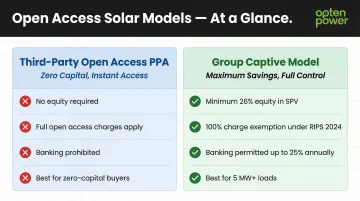
| Factor | Third-Party Open Access PPA | Group Captive Model |
|---|---|---|
| Equity required | None | Minimum 26% in project SPV |
| Open access charges | Full (wheeling, CSS, AS, transmission) | 100% exempt under RIPS 2024 |
| Banking | Prohibited | Permitted up to 25% annually (8% in-kind charge) |
| Best suited for | Buyers wanting zero capital commitment | Buyers with 5 MW+ load seeking maximum savings |
Rajasthan's Regulatory Framework for Solar PPAs
RERC and Open Access Regulations
The Rajasthan Electricity Regulatory Commission (RERC) governs open access solar procurement. The RERC Green Energy Open Access (GEOA) Regulations 2025 lowered the minimum contracted demand threshold from 1 MW to 100 kW, expanding access for smaller C&I buyers.
Approval process:
- NOC Authority: The respective DISCOM (JVVNL, AVVNL, JdVVNL) examines technical feasibility and issues the No Objection Certificate (NOC). If the DISCOM fails to communicate within 7 days, the NOC is deemed granted.
- Processing Timelines: Long-Term Open Access (LTOA) and Medium-Term Open Access (MTOA) applications are processed within 15 working days. Short-Term Open Access (STOA) applications must be submitted at least 7 days prior to the start date.
- Nodal Agencies: RVPN (Rajasthan Vidyut Prasaran Nigam) is the nodal agency for LTOA/MTOA; SLDC (State Load Dispatch Centre) handles STOA.
Key charges applicable to offsite solar PPAs in Rajasthan (FY 2025-26):
| Charge Type | Rate | Applicability |
|---|---|---|
| Wheeling Charges | ₹0.62/kWh at 11 kV; ₹0.12/kWh at 33 kV; ₹0.01/kWh at 132 kV+ | RERC Tariff Order |
| Transmission Charges | ₹170.79/kW/month (LTOA/MTOA) | RVPN Intra-State Transmission Tariff |
| Cross-Subsidy Surcharge (CSS) | ₹1.58/kWh (Large Industrial, Mixed Load) | RERC Tariff Order |
| Additional Surcharge (AS) | ₹0.72/kWh | RERC Tariff Order |
| Banking Charges | 8% in-kind deduction | RERC GEOA Regulations 2025 |
Rajasthan Solar Energy Policy and Government Incentives
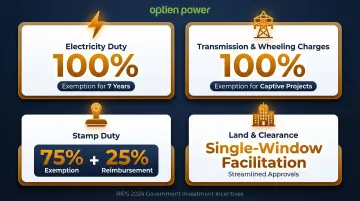
Rajasthan Investment Promotion Scheme (RIPS) 2024:
The RIPS 2024 provides significant incentives for captive renewable projects:
- 100% exemption from electricity duty for 7 years
- 100% exemption from transmission and wheeling charges (captive projects only)
- 75% exemption on stamp duty, with 25% reimbursement
- Land allotment facilitation and single-window clearance
National-level schemes:
- MNRE Ultra Mega Renewable Energy Power Park (UMREPP) Scheme: Under Mode 8, CPSUs/State PSUs can act as Solar Power Park Developers (SPPDs). Central Financial Assistance (CFA) of ₹20 lakh/MW or 30% of project cost is available for internal infrastructure development.
- Renewable Consumption Obligation (RCO): The Ministry of Power set the FY 2025-26 RCO target at 33.01% (28.24% Other RE, 2.10% Distributed RE, 1.45% Wind, 1.22% Hydro).
- RERC RCO Adoption: RERC adopted this framework via Suo Motu order on March 24, 2026. Non-compliance attracts penalties under Section 26(3) of the Energy Conservation Act, 2001.
Together, RIPS 2024 incentives and RCO mandates create both a financial case and a compliance driver for C&I buyers structuring solar PPAs in Rajasthan.
Financial Benefits: What C&I Businesses Can Expect to Save
Current DISCOM tariffs vs. solar PPA tariffs:
| Consumer Category | DISCOM Energy Charge | Fixed Charge | Typical Solar PPA Tariff (before OA charges) |
|---|---|---|---|
| Large Industrial (HT-5) | ₹6.50/kWh | ₹380/kVA/month | ₹3.50-5.50/kWh |
| Medium Industrial (HT-3) | ₹6.50/kWh | ₹275/kVA/month | ₹3.50-5.50/kWh |
Illustrative savings calculation for a 1 MW load consumer (offsite open access PPA):
Assumptions:
- Annual consumption: 15 lakh units (1 MW × 1,500 kWh/kW/year)
- DISCOM tariff: ₹6.50/kWh
- Solar PPA tariff: ₹4.00/kWh
- Open access charges: Wheeling ₹0.12/kWh (33 kV), CSS ₹1.58/kWh, AS ₹0.72/kWh, Transmission ₹0.11/kWh (₹170.79/kW/month ÷ 1,500 kWh/kW/year)
Net effective tariff: ₹4.00 (PPA) + ₹0.12 (wheeling) + ₹1.58 (CSS) + ₹0.72 (AS) + ₹0.11 (transmission) = ₹6.53/kWh
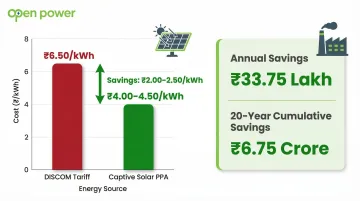
In this scenario, the net effective tariff is marginally higher than the DISCOM tariff. However, for captive projects under RIPS 2024, wheeling and transmission charges are waived, and CSS/AS are concessional, resulting in a net effective tariff of approximately ₹4.00-4.50/kWh—a saving of ₹2.00-2.50/kWh or 31-38% reduction.
Annual savings (captive model): 15 lakh units × ₹2.25/kWh (average saving) = ₹33.75 lakh/year
Over a 20-year PPA tenure, cumulative savings exceed ₹6.75 crore (assuming a fixed tariff with no escalation). These figures shift considerably depending on the developer's quoted tariff and project structure. Opten Power lets C&I buyers compare IRR and payback across multiple developers in real time — pulling from 4+ GW of available capacity across 16 states — so the most favourable deal is visible before any negotiation begins.
Non-financial benefits:
- Meets RPO/RCO obligations and avoids non-compliance penalties under Section 26(3) of the Energy Conservation Act, 2001
- Supports ESG and sustainability reporting — especially relevant for export-oriented industries with international disclosure requirements
- Locks in tariffs for 15-25 years, giving finance teams a reliable baseline for long-term cost planning
How to Sign a Solar PPA in Rajasthan: A Step-by-Step Process
Step 1 — Load Assessment and Structure Selection
Conduct a detailed energy audit to assess:
- Annual consumption (in units)
- Peak demand and load factor
- Consumption pattern (day/night, seasonal variation)
Use this data to determine:
- Optimal PPA capacity (typically 70-100% of daytime load for solar)
- Most suitable model (on-site, open access, or group captive)
- Eligibility for open access under RERC norms (minimum 100 kW contracted demand)
Step 2 — Developer Discovery, RFP, and Tariff Comparison
Identify qualified solar developers active in Rajasthan, issue a Request for Proposal (RFP), and evaluate bids on:
- PPA tariff and escalation rate
- Developer track record and financing strength
- O&M quality and performance guarantees
- Contract terms (deemed generation, force majeure, exit clauses)
Platforms like Opten Power can compress this stage considerably — automated RFP tools, pre-vetted contract templates, and real-time tariff comparisons across 4+ GW of Indian renewable capacity reduce procurement timelines by up to 50%, with instant IRR calculations to support bid evaluation.
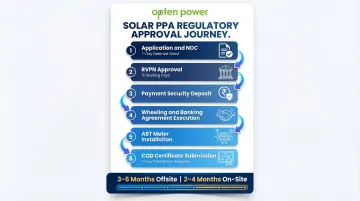
Step 3 — Regulatory Approvals, PPA Execution, and Commissioning
Regulatory workflow:
- Application & NOC: Submit application to DISCOM for NOC. If the DISCOM fails to communicate within 7 days, the NOC is deemed granted.
- Approval: RVPN processes LTOA/MTOA applications within 15 working days.
- Payment Security: Deposit 3 months of transmission, SLDC, wheeling, and CSS charges. Captive users are exempt from CSS/AS security deposits upon submitting a Rule 3 undertaking.
- Commercial Agreements: Execute the Wheeling and Banking Agreement (WBA) before commencement.
- Grid Connectivity: Install ABT-compliant Special Energy Meters (SEMs) capable of 15-minute block accounting, tested and sealed by the Distribution Licensee.
- Commissioning: Submit the COD (Commercial Operation Date) certificate 7 days prior to power flow commencement.
Timeline: From signing to commissioning typically takes 3-6 months for offsite projects, 2-4 months for on-site projects.
Legal due diligence: Scrutinise PPA terms on deemed generation, force majeure, payment security, and exit clauses. Engage legal counsel familiar with RERC regulations.
Frequently Asked Questions
What is a power purchase agreement for solar panels?
A solar PPA is a long-term contract where a developer installs and operates a solar plant at no cost to the buyer, who pays only for the electricity generated at a fixed per-unit tariff—avoiding upfront capital investment while benefiting from cheaper, cleaner power.
What is the subsidy for solar power in Rajasthan?
C&I businesses under third-party or open access PPA models do not qualify for direct capital subsidies (PM Surya Ghar targets residential consumers). They do benefit from RPO/RCO compliance credits, concessional open access charges under RIPS 2024, and MNRE scheme advantages for group captive structures.
What is the typical PPA duration for solar projects in Rajasthan?
Solar PPAs in Rajasthan are typically structured for 15 to 25 years, with tariff terms fixed or subject to a capped annual escalation (0-3%), providing long-term energy cost certainty to the offtaker.
What are open access charges applicable to solar PPAs in Rajasthan?
Offsite solar PPA buyers pay wheeling charges, transmission charges (₹170.79/kW/month), cross-subsidy surcharge (₹1.58/kWh), additional surcharge (₹0.72/kWh), and 8% in-kind banking charges as regulated by RERC. Captive projects under RIPS 2024 receive concessional rates on several of these components, improving net economics.
Is a solar PPA better than buying solar panels outright?
Outright ownership (CAPEX model) delivers higher long-term returns but demands significant upfront capital and ongoing O&M responsibility. A PPA eliminates both — zero investment, no operational risk — making it the better fit for businesses prioritising liquidity.
What minimum load is required to enter a solar open access PPA in Rajasthan?
RERC GEOA Regulations 2025 specify a minimum contracted demand threshold of 100 kW (single or aggregated within the same distribution division) for open access eligibility. On-site PPAs have no such minimum requirement.