Introduction
Many commercial and industrial consumers in Rajasthan struggle with high grid tariffs and limited control over their energy costs. Solar open access offers a direct solution: eligible businesses can procure renewable electricity directly from generators using the state's transmission and distribution network, bypassing full DISCOM dependence and reducing energy expenses by up to ₹6 per kWh.
Rajasthan's abundant solar irradiance, large industrial base, and the RERC Green Energy Open Access (GEOA) Regulations, 2025, have made the state one of India's most active C&I solar markets. In 2025, Rajasthan ranked 3rd nationally, contributing 18.2% of India's total solar open access additions. Yet navigating charges, BESS mandates, and the application process remains complex — especially as grid congestion intensifies.
This guide covers:
- What solar open access is and how it works
- Who qualifies under Rajasthan's 2025 GEOA rules
- The step-by-step application process
- Full charge structure, including wheeling and cross-subsidy
- BESS and banking requirements
- Common pitfalls to avoid
Key Takeaways
- Solar open access in Rajasthan lets eligible C&I consumers (100 kW+ contract demand) buy solar power directly from generators at potentially lower rates than DISCOM tariffs
- RERC's May 2025 Green Energy Open Access Regulations introduced BESS mandates, revised charges, banking provisions, and expanded captive plant eligibility up to 200% of contract demand
- Projects >5 MW on the STU network must install BESS at 5% capacity with 2-hour storage, which unlocks 75–100% exemptions on transmission and wheeling charges
- Applications are handled through the GOAR portal and routed to RVPNL for long/medium-term access or SLDC for short-term access
- Grid congestion, curtailment risks, and charge ambiguities remain key operational challenges C&I buyers must factor into project planning
What Is Solar Open Access?
Solar open access lets eligible commercial and industrial consumers buy solar (or other renewable) power from a generator of their choice — instead of accepting whatever rate their DISCOM charges. The framework operates under the Electricity Act, 2003, using existing transmission and distribution infrastructure on payment of designated charges. Unlike standard DISCOM supply, consumers can negotiate tariffs and select their generator directly.
Access Categories in Rajasthan:
The RERC GEOA Regulations 2025 define three access types:
- Long-term: More than 12 years, up to 25 years — suited for capital-intensive projects with fixed PPAs
- Medium-term: 3 months to 3 years, ideal for flexible sourcing or pilot projects
- Short-term: Up to one month for temporary or seasonal procurement needs
One point that often causes confusion: open access is not the same as rooftop solar. The two serve similar cost-reduction goals but work very differently in practice.
How Open Access Differs from Rooftop Solar:
Open access requires wheeling power through the grid from an off-site generator to your premises. Rooftop solar involves no grid transmission—panels sit on your roof and feed power directly to your facility. Open access projects require specific approvals, metering, and payment of charges (transmission, wheeling, surcharges) that don't apply to on-site systems.
Why Rajasthan Is One of India's Top Solar Open Access Markets
Exceptional Solar Resource
Rajasthan enjoys some of India's highest solar irradiance levels. According to the World Bank Global Solar Atlas, representative GHI levels are 2,056.8 kWh/m²/year in Jaisalmer, 2,035.6 kWh/m²/year in Barmer, and 2,022.1 kWh/m²/year in Jodhpur. As of March 31, 2026, Rajasthan's total installed solar capacity reached 41,012.62 MW, ranking 1st among Indian states.
In 2025, Rajasthan ranked 3rd nationally, contributing 18.2% (approximately 1.42 GW) of India's total 7.8 GW solar open access additions. However, Q4 2025 saw installations drop over 90% quarter-over-quarter due to severe transmission congestion and grid evacuation constraints.
Energy-Intensive Industrial Base
Rajasthan hosts a large concentration of C&I consumers—textiles, cement, mining, chemicals, and emerging data centres—all running against high grid tariffs. In 2024, total industrial electricity consumption reached 18,319.57 GWh, with cement alone at 4,795.43 GWh and textiles at 3,964.93 GWh. That scale of consumption makes even modest cost reductions per unit significant.
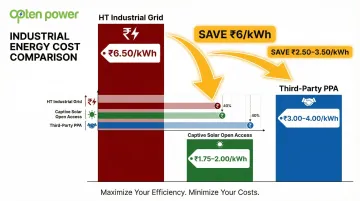
Typical Cost Savings (FY 2026-27):
| Supply Type | Landed Cost | Approx. Saving vs. Grid |
|---|---|---|
| HT Industrial Grid | ₹6.50/kWh | — |
| Captive Solar Open Access | ₹1.75–2.00/kWh | ~₹6/kWh (incl. demand charges) |
| Third-Party PPA | ₹3.00–4.00/kWh | ₹2.50–3.50/kWh |
Favourable Policy Environment
The RERC GEOA Regulations 2025 made three meaningful changes for the market:
- Expanded captive plant capacity limits to 200% of contract demand
- Introduced BESS charge exemptions to encourage storage-backed projects
- Clarified hybrid project eligibility, reducing developer uncertainty
These changes improve long-term viability for both developers and C&I buyers. Transmission infrastructure remains a bottleneck — grid evacuation constraints triggered a sharp Q4 2025 slowdown — but the policy direction is firmly pro-open-access.
How Solar Open Access Works in Rajasthan: Process and Eligibility
Eligibility Under RERC GEOA 2025
Who Qualifies:
- Consumers with contract demand or sanctioned load of 100 kW or more (single connection or multiple connections aggregating 100 kW within the same electricity division of a distribution licensee)
- Captive generating plant consumers face no lower consumption limit
- Hybrid renewable projects are eligible, with GEOA quantum based on the total connectivity of the hybrid project rather than individual component capacities
Captive Plant Capacity Ceiling:
New captive renewable energy plants may be sized up to 200% of the consumer's contract demand, giving businesses room to generate surplus energy beyond immediate consumption needs. However, plants exceeding 100% of contract demand trigger mandatory BESS requirements.
Multiple Connections:
Entities with connections aggregating 100 kW in the same electricity division may submit a unified GEOA application. Application fees are structured as a base fee covering the first injection and drawal point, with incremental fees for each additional drawal point, which keeps aggregation cost-effective for multi-site businesses.
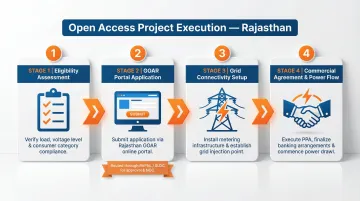
Step 1: Choose Access Type and Assess Eligibility
Before applying, work through four decisions:
- Determine whether long-term, medium-term, or short-term open access fits your energy profile and capital plan
- Verify your contract demand meets the 100 kW threshold
- For captive plants, check whether capacity will exceed contract demand and budget for BESS if so
- If you lack prior grid connectivity, confirm you hold valid connectivity feasibility approvals before using the conditional open access route
Step 2: Select a Developer and Submit Application via the GOAR Portal
Applications are submitted through the Green Energy Open Access Registration (GOAR) portal. For interstate open access under GNA/T-GNA, interoperability between NOAR, GOAR, and the state portal is available, with data from NOAR/GOAR deemed valid for the state portal.
Application Routing:
- Long and medium-term access applications are routed to RVPNL (STU) as the State Nodal Agency
- Short-term access goes to the SLDC
Application Fees:
- Short-term: ₹5,000
- Medium-term: ₹20,000
- Long-term: ₹1,00,000
Bank guarantees and security deposits covering three months of applicable charges are required alongside the application.
Platforms like Opten Power enable C&I buyers to compare solar developers, evaluate tariffs, and assess project economics in Rajasthan before committing to a developer. The platform provides real-time tariff comparisons, instant IRR and payback calculations, and standardized regulatory analysis across multiple developer proposals.
Step 3: Commission the Project and Begin Power Flow
Once approved, physical grid connectivity must be established at least 30 days before the intended date of power flow (for conditional open access cases). Metering requirements apply at three points:
- Generator end
- Interface points
- Consumption premises
All meters must meet Central Electricity Authority standards and be inspected and sealed by the Distribution Licensee.
Commercial Agreements:
For long-term access, a commercial agreement must be signed. Failure attributable to force majeure events exempts the applicant from cancellation and bank guarantee encashment. If the project faces a default notice, a 15-day cure window is available before suspension, with restoration possible on payment of dues and a ₹25,000 restoration fee.
Key Charges, BESS Mandates, and Banking Provisions Under RERC GEOA 2025
Charge Structure for C&I Consumers
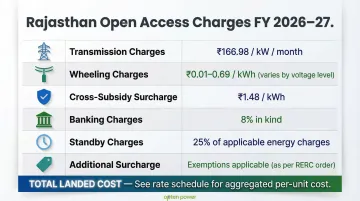
Under RERC GEOA 2025, open access consumers procuring solar power in Rajasthan are subject to the following charges — knowing these upfront is essential for accurate PPA pricing and savings projections:
Transmission Charges:
For use of high-voltage interstate/intrastate lines, determined by the Commission. ₹166.98/kW/month for long/medium-term access; ₹5.49/kW/day for short-term access.
Wheeling Charges (FY 2026-27):
Cross-Subsidy Surcharge (CSS):
Fixed at ₹1.48/kWh across all categories and voltage levels for FY 2026-27 (unless exempted).
Additional Surcharge:
Not applicable when consumers pay fixed charges up to contract demand, nor applicable for captive plants, MSW-to-energy plants, offshore wind projects commissioned before December 2032, or green hydrogen/ammonia production.
Standby Charges:
25% of energy charges for the applicable tariff category, waived if one day's advance notice is given before DAM closure time.
Banking Charges:
8% of banked energy units, deducted in kind.
"Any Other Charges" Category:
RERC GEOA 2025 includes a residual "any other charges" category not defined in advance. Consumers and developers should request explicit clarification from the DISCOM before executing agreements to avoid unexpected cost additions.
BESS Mandate Details
For Open Access Projects >5 MW on STU Network:
A BESS storing at least 5% of plant capacity for a minimum of 2 hours is mandatory.
For Captive Plants Sized Between 100–200% of Contract Demand:
A BESS storing at least 20% of the energy generated above the 100% threshold (calculated at normative CUF/PLF per RERC RE Tariff Regulations 2020) is required.
Security Deposits for Captive Plants:
Exclude cross-subsidy surcharge and additional surcharge components, provided an undertaking on plant status is submitted.
BESS Charge Exemptions as a Financial Incentive
Installing BESS equivalent to 5% of RE plant capacity gives a 75% reduction in transmission and wheeling charges for 7 years. This exemption scales up to 100% when BESS capacity reaches 30% of plant capacity.
Additional Exemptions:
- Standalone BESS projects supplying power during peak/non-solar hours receive a 100% exemption
- BESS at 11 kV or 33 kV substations receives a 100% exemption
Program Cap:
These exemptions apply to the first 2,000 MW of BESS in the state or until 2030, whichever comes first—making early adoption advantageous.
Energy Banking Provisions
Banking is allowed up to 100% of capacity or up to 200% of contract demand. Surplus energy injected into the grid is credited to the consumer's account and can be drawn later. A banking charge of 8% of banked energy units is deducted in kind.
Key Rules:
- Any unutilized banked energy lapses at the end of the financial year, but the plant becomes eligible for Renewable Energy Certificates (RECs) for lapsed units
- A Wheeling and Banking Agreement with the Distribution Licensee is mandatory to use the banking facility
- Banking provisions apply to both new and existing projects until March 31, 2030
Green Energy Tariff and Certificate Provisions
Key provisions for consumers procuring green energy under RERC GEOA 2025:
- Consumers can procure green energy for part or all of their consumption — tariffs are set separately by RERC, so confirm current rates before finalizing PPAs
- The distribution licensee issues an annual Green Certificate for purchases exceeding mandatory RPO obligations
- RERC may introduce a consumer rating system based on green energy share — early, above-compliance procurement could carry future regulatory advantages
Common Challenges and Misconceptions in Rajasthan's Open Access Market
Grid Evacuation Bottleneck
A common misconception is that project approval guarantees power delivery. In practice, Rajasthan faces transmission congestion, limited substation access, and curtailment risks. Nearly 4 GW of commissioned renewable capacity in Rajasthan faces curtailment during peak solar hours (11 AM to 2 PM). Curtailment rates spiked from 8.5% in March 2025 to 51.5% by August 2025.
What to Do:
Verify evacuation infrastructure before commissioning, not after. Key checks at the planning stage:
- Confirm substation capacity and available slots with RVPNL
- Assess line congestion on the proposed evacuation route
- Review RVPNL's transmission upgrade schedule and timelines
- Evaluate curtailment risk during 11 AM–2 PM peak solar hours
Charge Calculation Errors
C&I consumers routinely underestimate the total landed cost of open access power by overlooking standby charges, banking charges, and the "any other charges" category. The correct comparison is the open access landed price (generator tariff + all applicable OA charges) versus the full DISCOM tariff including fixed charges—not just the energy charge component.
Example:
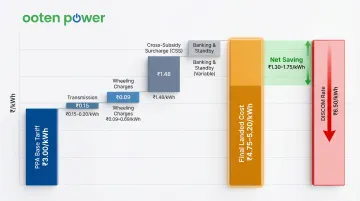
A ₹3.00/kWh PPA tariff looks attractive against a ₹6.50/kWh DISCOM energy charge. Factor in all applicable costs and the picture changes:
- Transmission charges: ₹0.15–0.20/kWh
- Wheeling charges: ₹0.09–0.69/kWh (varies by voltage level)
- Cross-subsidy surcharge (CSS): ₹1.48/kWh
- Banking charges: 8% in kind
- Standby charges: applicable where relevant
The actual landed cost lands at ₹4.75–5.20/kWh. That's still a meaningful saving—but roughly half of what the headline tariff comparison suggests. Build the full cost stack before signing a PPA.
BESS Planning Gap
Smaller developers and consumers often treat BESS as an optional upgrade or a future consideration. Under Rajasthan's 2025 rules, BESS is already mandatory for projects >5 MW on the STU network and for captive plants exceeding 100% contract demand.
Skipping BESS at the design stage creates unexpected capital costs, risks commissioning delays, and can disqualify a project from charge exemptions entirely.
What to Do:
Price BESS into your feasibility study from day one, not as an afterthought:
- A 10 MW project requires 5% BESS (500 kW, 2-hour storage) at approximately ₹2.5–3 crore
- The 75–100% exemption on transmission and wheeling charges over 7 years can save ₹1–2 crore annually
- Net of BESS costs, the exemption typically pays back the storage investment within 2–3 years
Frequently Asked Questions
What is the minimum contract demand required for solar open access in Rajasthan?
The RERC GEOA Regulations 2025 require a minimum contract demand or sanctioned load of 100 kW, from a single connection or multiple connections in the same electricity division aggregated together. Captive generating plant consumers face no lower limit.
Is BESS mandatory for all solar open access projects in Rajasthan?
BESS is mandatory for open access projects above 5 MW on the STU network (minimum 5% of plant capacity, 2-hour duration) and for captive plants with capacity between 100–200% of contract demand. Projects below 5 MW on the distribution network are exempt.
What charges apply to solar open access consumers in Rajasthan?
Key applicable charges include:
- Transmission charges
- Wheeling charges (₹0.01–0.69/kWh depending on voltage level)
- Cross-subsidy surcharge (₹1.48/kWh)
- Additional surcharge (exemptions apply)
- Banking charges (8% in kind)
- Standby charges
Rates are set by RERC and vary by project type.
How does energy banking work under Rajasthan's GEOA regulations?
Surplus energy from a captive plant is injected into the grid and credited to the consumer's account. This banked energy can be drawn when consumption exceeds generation, subject to an 8% banking charge deducted in kind. Any unused balance lapses at year-end but qualifies for Renewable Energy Certificates (RECs).
What is the difference between short-term, medium-term, and long-term open access in Rajasthan?
Short-term access covers up to one month; medium-term covers 3 months to 3 years; long-term covers 12 to 25 years and is managed by the STU (RVPNL). Short-term suits flexible procurement, while long-term is designed for large, committed project investments.
Can entities with multiple small connections aggregate to meet the 100 kW eligibility threshold?
Yes. Entities with multiple connections totalling 100 kW or more within the same electricity division may submit a single unified GEOA application. A base application fee applies, with an incremental fee for each additional drawal point.