Introduction
India's Ministry of Power issued a revised notification in September 2025 that sets a 33.01% Renewable Consumption Obligation (RCO) for FY 2025-26. The mandate applies to DISCOMs, captive power plant owners, and commercial and industrial (C&I) consumers on open access — and the compliance environment has never been stricter.
Many obligated entities remain uncertain about the details: which percentages apply, what counts as compliant, and how RECs factor in. Enforcement has now shifted to the Energy Conservation (Amendment) Act 2022 — away from historically lenient state commission oversight.
The stakes are real. Penalties can reach Rs 10 lakh per failure, with additional surcharges calculated on oil equivalent pricing.
This article breaks down the 2026 RCO framework — who must comply, which pathways are available, how state-level variations affect procurement, and how C&I consumers can convert this obligation into a cost reduction opportunity.
TLDR:
- FY 2025-26 mandates 33.01% renewable consumption with sub-targets: wind (1.45%), hydro (1.22%), distributed RE (2.10%)
- Open access threshold cut from 1 MW to 100 kW — thousands of mid-sized facilities now qualify as obligated entities
- Compliance options: direct PPAs, market-traded RECs, or CERC's buyout price fixed at Rs 347/MWh
- Penalties now reach Rs 10 lakh per failure plus oil equivalent surcharges under the Energy Conservation Act
- Corporate PPAs can satisfy RCO requirements while cutting energy costs by up to 40%
What Are Renewable Purchase Obligations (RPOs)?
Renewable Purchase Obligations (RPOs) are legally mandated requirements that compel specific entities to source a minimum percentage of their electricity consumption from renewable energy sources. Established under the Electricity Act 2003 and the Energy Conservation Act 2001, these obligations are set nationally by the Ministry of New and Renewable Energy (MNRE) and enforced through State Electricity Regulatory Commissions (SERCs) and the Bureau of Energy Efficiency (BEE).
Who Must Comply:
Obligated entities include:
- Distribution companies (DISCOMs) supplying electricity to end consumers
- Open access consumers with contracted demand of 100 kW or more
- Captive power plant owners of any size, regardless of capacity
- Large C&I facilities sourcing power directly rather than through their local DISCOM
The Framework Underpinning the Obligation
Section 86(1)(e) of the Electricity Act 2003 originally authorized state commissions to specify renewable purchase percentages. Under Section 14(x) of the Energy Conservation Act 2001, the Central Government can now mandate minimum non-fossil electricity shares for designated consumers. This legal foundation makes RPO compliance a statutory requirement with enforceable penalties, not an optional ESG initiative.
From Technology-Agnostic to Technology-Specific Mandates
India's RPO framework has evolved considerably over the past decade, shifting from broad renewable targets to detailed, technology-specific mandates. Early RPO regulations simply required a total renewable percentage without distinguishing between sources. The current framework sets distinct, technology-specific targets:
- Solar RPO (falling under "Other RE" in the latest notification)
- Non-solar RPO including wind, small hydro, biomass, and biogas
- Hydro purchase obligation for large hydroelectric projects
- Distributed renewable energy from projects smaller than 10 MW
This granular approach prevents entities from meeting obligations solely through the cheapest or most available technology, driving balanced development across India's diverse renewable energy portfolio.
The 2026 targets reflect this structured approach, with separate escalation trajectories for each technology category — all building toward the 2030 national goal of 500 GW installed renewable capacity and 50% electricity from non-fossil sources.
India's 2026 RPO Targets: What the Numbers Actually Mean
The Ministry of Power's September 2025 notification establishes a total RCO of 33.01% for FY 2025-26, up from 29.91% the previous year — a 3.1 percentage point increase. The total is made up of four distinct technology-specific mandates that obligated entities must meet individually.
Breaking Down the 33.01% Mandate
The FY 2025-26 target comprises:
| Technology Category | Percentage Requirement | What Qualifies |
|---|---|---|
| Wind RE | 1.45% | Wind power projects |
| Hydro RE | 1.22% | Large hydroelectric projects |
| Distributed RE | 2.10% | Projects under 10 MW (solar, biomass, small hydro) |
| Other RE | 28.24% | Solar, biomass, biogas, and other qualifying sources |
| Total RCO | 33.01% | Combined obligation |
According to the Ministry of Power's RPO notification, these percentages apply as a share of total electrical energy consumption. For DISCOMs, this calculation is based on energy supplied to consumers within their distribution area. For open access and captive consumers, the obligation applies to electricity consumed from sources other than the distribution licensee.
The Escalation Trajectory: 2026 to 2030
The 2026 target sits within a steep year-on-year escalation path designed to reach 43.33% by FY 2029-30:
- FY 2024-25: 29.91% total (0.67% wind, 0.38% hydro, 1.50% distributed, 27.36% other)
- FY 2025-26: 33.01% total (1.45% wind, 1.22% hydro, 2.10% distributed, 28.24% other)
- FY 2026-27: 35.95% total (1.97% wind, 1.34% hydro, 2.70% distributed, 29.94% other)
- FY 2027-28: 38.81% total (2.45% wind, 1.42% hydro, 3.30% distributed, 31.64% other)
- FY 2028-29: 41.36% total (2.95% wind, 1.42% hydro, 3.90% distributed, 33.09% other)
- FY 2029-30: 43.33% total (3.48% wind, 1.33% hydro, 4.50% distributed, 34.02% other)
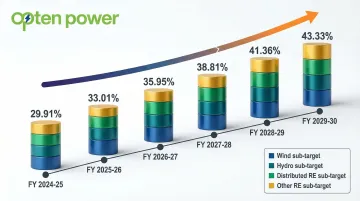
Each year's increase layers onto the last. Entities that fall behind on cumulative compliance face steeper catch-up burdens in subsequent years — they must meet current-year targets while clearing previous shortfalls at the same time.
Calculating Your Actual Obligation
The RCO applies as a percentage of total consumption, but the base calculation differs by entity type:
For DISCOMs: Total RCO percentage × (total energy supplied to consumers - open access consumption - captive consumption)
For open access consumers: Total RCO percentage × total electricity consumed from sources other than the local DISCOM
For captive power plant owners: Total RCO percentage × total electricity consumed from the captive plant
Each of these formulas feeds into technology-specific sub-targets that must be met individually. Excess solar procurement cannot offset a wind shortfall, which means portfolio planning needs to span multiple renewable sources and procurement mechanisms from the outset.
How Power Utilities Can Achieve RPO Compliance
Obligated entities have three primary pathways to demonstrate RCO compliance, each with distinct economic profiles and strategic applications.
Direct Procurement Through Long-Term PPAs
The most cost-effective approach for meeting ongoing obligations is signing long-term or medium-term Power Purchase Agreements directly with renewable energy developers. These contracts lock in fixed tariffs over project lifetimes—typically 20-25 years—providing cost predictability and protection against future price volatility.
Recent CERC data shows direct PPAs consistently deliver lower lifecycle energy costs than spot market REC purchases, particularly for baseload compliance requirements.
DISCOMs and large C&I consumers issue requests for proposals through competitive bidding or bilateral negotiations with developers. Once executed, renewable electricity flows directly to the obligated entity's grid connection point, with generation volumes automatically counting toward RCO compliance through SERC reporting mechanisms.
Platforms like Opten Power's automated tender engine can cut this procurement cycle up to 50% faster, with real-time DISCOM intelligence across 16 states and instant IRR analysis across 4+ GW of available capacity.
Renewable Energy Certificates (RECs)
RECs are tradeable instruments representing the environmental attributes of renewable generation — one REC equals one MWh of renewable electricity injected into the grid. Under the CERC REC Regulations 2022, they are traded on authorised power exchanges, primarily IEX and PXIL.
Trading sessions are held fortnightly — on the second and last Wednesday of each month.
CERC eliminated mandatory floor and forbearance prices in 2022, so REC pricing is now driven purely by market forces — creating volatile costs that fluctuate with supply-demand dynamics each session.
RECs work best for short-term compliance gap-filling. Use them when:
- Physical renewable procurement isn't immediately available
- Grid connectivity constraints prevent direct power wheeling
- Specific technology types (wind, hydro) aren't accessible in your service area
Avoid relying on RECs as a long-term strategy. Price unpredictability and supply shortages during high-demand periods make them an unreliable primary compliance mechanism.
CERC's Buyout Price Mechanism
Introduced as a compliance safety net, the buyout price allows obligated entities to make standardised payments directly to the Central Energy Conservation Fund when physical renewable energy or RECs are unavailable. For FY 2025-26, the buyout price is fixed at Rs 347/MWh and will escalate by 5% annually through FY 2029-30.
This price effectively caps maximum compliance costs during REC market volatility. Treat Rs 347/MWh as a risk management ceiling: any direct PPA tariff below this figure delivers measurable savings versus the buyout alternative.
That said, buyout payments are not a substitute for actual renewable procurement. Regulators treat this as a last-resort mechanism — entities relying heavily on buyout payments risk additional scrutiny during tariff approvals and licence renewals.
Open Access Renewable Procurement
C&I consumers and captive plant owners can meet RCO obligations through third-party open access arrangements or group captive structures. This route allows businesses to purchase renewable power directly from generators through the grid transmission network, bypassing their local DISCOM.
Key economic considerations:
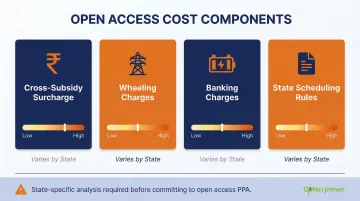
- Cross-subsidy surcharge (CSS): Charges to compensate DISCOMs for lost revenue
- Wheeling charges: Transmission network usage fees
- Banking charges: Costs for storing excess generation for later consumption
- State-specific scheduling rules: Administrative requirements that vary by SERC
These charges vary significantly by state and can substantially impact the landed cost of open access power. Granular state-level analysis is essential before committing to an open access PPA.
Documentation and Reporting Requirements
RCO compliance requires meticulous record-keeping. Obligated entities must:
- Maintain detailed documentation of renewable energy consumption
- Submit annual compliance reports to their respective SERC
- Provide REC retirement evidence where applicable
The Bureau of Energy Efficiency oversees centralised compliance monitoring. Failure to submit proper documentation is treated as non-compliance — even when actual renewable consumption occurred.
State-Level Variations in RPO Requirements
While the national RCO framework sets unified targets, state-level implementation creates significant economic variations that obligated entities must navigate carefully.
Why State Variations Persist
Although the Ministry of Power's September 2025 notification establishes centralised RCO targets, individual State Electricity Regulatory Commissions retain authority over crucial implementation details: open access charges, banking regulations, scheduling procedures, and penalty structures. The basic percentage obligation may be uniform, but the economic cost of meeting it varies widely depending on which state an entity operates in.
State-Specific Examples of Variation
Tamil Nadu: TNERC recently approved an additional surcharge of ₹0.10/kWh for open access power consumers to recover stranded fixed costs, effective April 2025 through September 2025. This temporary but significant charge directly impacts the economics of corporate PPAs in the state.
Karnataka: The Karnataka Electricity Regulatory Commission issued comprehensive 2025 Open Access Regulations that restructure wheeling charges, cross-subsidy surcharges, and banking provisions, creating a distinctly different cost structure than neighbouring states.
Telangana: TGERC approved an additional surcharge of ₹1.09/kWh for the second half of FY 2024-25 to compensate DISCOMs for stranded capacity costs—though this charge explicitly does not apply to consumers wheeling power from their own captive plants, creating different economics for different procurement models.
Navigating Multi-State Compliance
Obligated entities operating across multiple states—common for large C&I groups, industrial conglomerates, and independent power producers—must track SERC orders in each jurisdiction of operation. Each state can differ across several dimensions:
- Compliance percentages and eligible technology definitions
- Reporting deadlines and submission formats
- Penalty structures for non-compliance
- Banking and scheduling provisions
This requires procurement strategies and compliance tracking tailored to each state's regulatory environment—not a single unified approach.
Penalties and Enforcement for Non-Compliance
The enforcement landscape has fundamentally shifted from historically lenient state oversight to strict central regulation under the Energy Conservation Act framework.
The New Penalty Structure
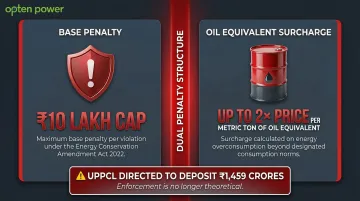
Under Section 26(3) of the Energy Conservation (Amendment) Act 2022, entities failing to meet RCO targets face two penalty components:
Base penalty: Up to ₹ 10 lakh for each compliance failure
Oil equivalent surcharge: An additional penalty not exceeding twice the price of every metric ton of oil equivalent in excess of prescribed norms
This dual-penalty structure can result in substantial financial liabilities, particularly for large-scale shortfalls. Unlike previous state-level penalty regimes that often went unenforced, the ECA framework brings mandatory, centrally monitored compliance.
Escalating Enforcement Trends
Regulatory scrutiny has intensified since 2022-23 following Ministry of Power and MNRE enforcement directives. State commissions are now issuing show-cause notices and levying penalties that were rarely applied in previous years. The Uttar Pradesh Electricity Regulatory Commission, for instance, directed UPPCL to deposit ₹1,459.34 crores into an RPO fund for historical compliance shortfalls — a figure that signals how quickly liabilities accumulate. With BEE's centralised monitoring now in place, similar enforcement actions are expected to become routine in 2026.
The Phasing Out of Alternate Compliance Payments
Some state regulations historically allowed entities to make "alternate compliance payments" (ACP) instead of procuring actual renewable energy. This option provided a predictable cost ceiling but did nothing to advance renewable capacity development. With the introduction of CERC's buyout price mechanism and the removal of REC forbearance prices, traditional state-level ACPs are being phased out or replaced by the central framework.
The regulatory direction is clear: procure actual renewable energy or face escalating costs. Buyout payments remain available for now, but relying on them as a primary compliance route leaves entities exposed to both rising buyout prices and tightening enforcement.
What C&I Consumers Need to Know About Renewable Obligations
Commercial and industrial consumers face distinct compliance dynamics and strategic opportunities compared to DISCOMs.
When C&I Facilities Become Obligated Entities
The Green Energy Open Access Rules 2022 redefined the threshold for obligated entities as any consumer with contracted demand or sanctioned load of 100 kW or more—a dramatic reduction from the previous 1 MW requirement. Additionally, all captive power plant owners face RCO obligations regardless of size.
This regulatory change brings thousands of mid-sized facilities into the compliance net: large hotels, hospital complexes, IT parks, manufacturing plants, cold storage facilities, and commercial buildings. These entities cannot transfer their obligation to their local DISCOM when they source power directly through open access arrangements or captive generation.
Corporate PPAs as Compliance and Cost Reduction
C&I consumers can transform regulatory obligation into commercial advantage by signing corporate PPAs directly with renewable energy developers. These agreements simultaneously fulfill RCO mandates and reduce energy costs—often by up to 40% compared to grid tariffs.
Large electricity consumers—data centers, hospitals, steel plants, cement manufacturers, IT parks, and hotels—sign long-term contracts with solar, wind, or hybrid project developers. The renewable power is wheeled through the transmission network to their facilities, displacing expensive grid electricity while satisfying technology-specific RCO sub-targets.
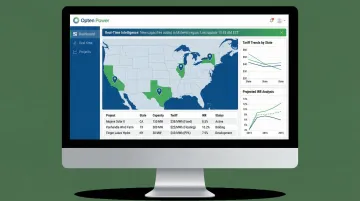
Opten Power gives C&I procurement teams access to 4+ GW of solar, wind, and hybrid projects across 16 states. Real-time tariff comparison, instant IRR and payback analysis, and full visibility into state-specific charges help teams identify the most cost-effective RCO-compliant option—and execute contracts 50% faster than traditional bilateral negotiations.
Meeting 24x7 Baseload Requirements
PPAs work well for facilities with standard operating hours, but round-the-clock consumers face a harder problem. Heavy industries, data centers, and process facilities must meet RCO targets without compromising continuous power availability. Hybrid renewable projects combining solar, wind, and storage—or portfolios of PPAs with complementary generation profiles—can satisfy both requirements at once.
Solar + wind complementarity: Solar generation peaks during daytime business hours while wind resources often strengthen during evening and night hours. Structuring PPAs across both technologies creates a more balanced generation profile that aligns with 24x7 consumption patterns and meets both the wind and other RE sub-targets within the RCO framework.
ESG and Sustainability Reporting Benefits
Meeting RCO obligations through documented PPAs or retired RECs feeds directly into ESG disclosures across multiple frameworks:
- GRI standards for environmental reporting
- SEBI's BRSR (Business Responsibility and Sustainability Reporting) requirements
- Supply chain decarbonisation commitments for Scope 3 emissions
For enterprises with international customers, investors, or sustainability rating scrutiny, RCO compliance delivers dual value: regulatory adherence and stronger corporate sustainability credentials.
Frequently Asked Questions
What requires utilities to source a minimum percentage of their energy from renewable generation?
India's Renewable Purchase Obligation framework, established under the Electricity Act 2003 and operationalised through MNRE notifications and SERC orders, legally requires DISCOMs, open access consumers, and captive power plant owners to procure a defined minimum share of electricity from renewable sources annually.
What is the difference between RPO and REC in India?
RPO (now RCO under the Energy Conservation Act) is the obligation—the percentage target entities must meet. A Renewable Energy Certificate (REC) is one compliance instrument representing 1 MWh of renewable electricity that can be traded on power exchanges by entities unable to procure renewable power physically.
What happens if a power utility fails to meet RPO targets?
Non-compliant entities face penalties up to ₹10 lakh per failure plus additional charges based on oil equivalent pricing under Section 26(3) of the Energy Conservation Act. These penalties are deposited into the Central Energy Conservation Fund, and persistent non-compliance can affect tariff approvals and license renewals.
Do commercial and industrial consumers have separate renewable energy obligations?
Yes. Large C&I consumers with open access connections or captive plants above the 100 kW threshold are classified as obligated entities under RCO rules and must meet targets independently. They cannot transfer this obligation to their DISCOM when sourcing power directly.
What types of renewable energy count toward RPO compliance in India?
Eligible sources fall into three tracked categories:
- Solar (classified under "Other RE" in compliance filings)
- Non-solar renewables: wind, small hydro, biomass, and biogas
- Large hydro: tracked separately under the Hydro Purchase Obligation
The distributed RE category covers projects under 10 MW across all technologies.
How is India's RPO target expected to change after 2026?
India's RCO follows a year-on-year escalation trajectory reaching 43.33% by FY 2029-30, aligned with the national goal of 500 GW renewable installed capacity. Securing long-term procurement contracts ahead of annual deadlines helps avoid last-minute shortfalls and REC price volatility.