Introduction
Pune's industrial landscape is under real cost pressure. The city's automotive OEMs, pharma manufacturers, and engineering clusters — including names like Tata Motors, Bajaj Auto, and Emcure Pharmaceuticals — together account for approximately 42.73% of Maharashtra's total electricity consumption.
MERC's FY 2024-25 tariff orders set HT commercial electricity rates at ₹14.08/kVAh, among the highest in India, with HT industrial tariffs at ₹8.98/kVAh. As grid costs climb each successive tariff cycle, C&I businesses are turning to alternatives that offer both cost predictability and sustainability credentials.
Renewable energy Power Purchase Agreements (PPAs) have emerged as the primary tool for high-consumption businesses to escape grid tariff volatility. This guide covers what you need to know to evaluate and execute one in Pune:
- The three main PPA structures available in Maharashtra
- The open access regulatory framework and how it applies to your load profile
- Typical costs, savings ranges, and contract terms
- The step-by-step process from issuing an RFP to project commissioning
Key Takeaways
- A renewable energy PPA is a long-term contract where a developer builds and operates a solar or wind plant while you pay only for the power consumed—no upfront capital required
- Pune businesses save nearly 55% on energy costs versus grid tariffs while meeting ESG and Scope 2 emission reduction targets
- Three PPA types serve different needs: rooftop on-site, open access off-site, and group captive schemes
- Maharashtra's open access threshold is now just 100 kW, opening renewable procurement to smaller facilities that aggregate load
- Typical execution runs 6–12 months from RFP to commissioning
What Is a Renewable Energy PPA and How Does It Work?
A Power Purchase Agreement (PPA) is a contract between a renewable energy developer and a business consumer. The developer finances, builds, owns, and operates the solar or wind plant. You agree to purchase the electricity generated at a pre-agreed tariff for a fixed term—typically 10 to 25 years. Because the developer retains asset ownership, you avoid capital investment in renewable energy infrastructure entirely.
Three parties drive every PPA structure:
- The Developer/IPP finances, builds, and operates the plant throughout the contract term
- Your business (the offtaker) commits to purchasing power at the agreed rate
- MSEDCL (Maharashtra's DISCOM) handles open access approvals, wheeling charges, and grid connectivity for off-site projects
Rooftop vs. Open Access PPAs
On-site/Rooftop PPAs install solar panels directly on your facility's roof or available land. Power is consumed on-site with minimal transmission losses — the developer owns the system and you pay per unit consumed. This model suits Pune's industrial campuses, manufacturing facilities, warehouses, and IT parks with adequate roof space.
Open access/Off-site PPAs source power from utility-scale solar or wind parks in districts like Solapur, Satara, or Ahmednagar. Electricity is "wheeled" to your grid connection point via Maharashtra's state transmission network. This structure works for businesses lacking roof space or needing capacities beyond what rooftop installations can deliver.
Before signing, four contract terms demand close attention:
- Tenure runs 10–25 years; longer terms often mean lower tariffs but require careful review of exit clauses
- Tariff structure determines whether your rate is fixed or escalates annually — each has different long-term cost implications
- Minimum offtake obligations set contractual consumption floors you must meet regardless of actual usage
- Exit and termination provisions define penalties, notice periods, and any buyout options available to your business
Why Pune Businesses Are Choosing Renewable PPAs Now
Maharashtra's Grid Tariff Challenge
MERC's tariff orders for FY 2024-25 highlight the financial burden on C&I consumers:
| Category | Energy Charge (₹/kVAh) |
|---|---|
| HT I (Industry - General) | 8.98 |
| HT II (Commercial) | 14.08 |
| HT III (Railways/Metro) | 7.94 |
Commercial buyers face rates approaching ₹14 per unit, while even industrial consumers pay nearly ₹9/kVAh—well above renewable PPA tariffs. With utility-scale solar recording rates of ₹2.52–₹2.91/kWh in recent Maharashtra tenders, the savings gap runs to ₹6–₹11 per unit for commercial consumers.
Maharashtra's Enabling Open Access Framework
Maharashtra's open access regulations have been liberalized steadily. The MERC Distribution Open Access (Second Amendment) Regulations, 2023, reduced the eligibility threshold for green energy open access to just 100 kW—down from 1 MW. Consumers can aggregate multiple connections within the same electricity division to meet this threshold, unlocking off-site solar procurement for mid-sized MSMEs in Pune's auto and engineering clusters.
Sustainability and ESG Drivers
Corporate commitments to RE100, net-zero targets, and Scope 2 emission reduction are accelerating PPA adoption. Pune-based leaders have already moved:
- Tata Motors signed a 131 MW wind-solar hybrid group captive PPA with Tata Power Renewable Energy to supply six manufacturing facilities across Maharashtra and Gujarat
- Emcure Pharmaceuticals secured 22.78 MWp of solar power from Sunsure Energy's 150 MWp Solapur park via a group captive arrangement
These deals demonstrate that renewable PPAs deliver both cost savings and certified renewable energy for ESG reporting.
Financial Certainty
Beyond ESG, there is a straightforward financial case. Grid tariffs face annual MERC revisions and rising cross-subsidy burdens—costs that compound unpredictably over time. A fixed-rate PPA locks in your energy cost for 15–25 years, protecting against future hikes and making long-term financial planning considerably more reliable.
Types of Renewable Energy PPAs Available in Pune
Rooftop On-Site PPA
The developer installs solar panels on your facility's roof at zero upfront cost. You pay a per-unit tariff for the electricity consumed. System size is limited by available roof area, making this ideal for:
- Factories and manufacturing plants
- Warehouses and distribution centres
- IT parks and commercial complexes
- Pharmaceutical campuses
Installation is typically faster (3–6 months) since there's no need for transmission approvals or wheeling arrangements.
Open Access Off-Site PPA
A remote utility-scale solar or wind park—such as those in Solapur, Ahmednagar, or Satara—generates power and wheels it to your Pune facility via the state grid. You pay the base PPA tariff plus applicable charges:
- Wheeling charges: ₹0.60/kVAh (FY 2024-25)
- Transmission charges: ₹0.48/kVAh for short-term or ₹310.98/kW/month for long-term
- Additional surcharge: ₹1.36/kVAh (applies to all open access consumers)
- Cross-subsidy surcharge (CSS): ₹1.79/kVAh for third-party open access (exempt for group captive)
Even with these charges, total landed cost remains well below grid tariffs for eligible consumers.
Group Captive Scheme
Under the Electricity Act and the Electricity (Amendment) Rules, 2022, a group of companies can jointly acquire at least 26% equity in a captive power plant and offtake power proportionally. Key regulatory benefits:
- Consumption test made collective: The 51% captive consumption requirement is now measured across all captive users collectively, not individually
- Subsidiary aggregation: Holding companies and their subsidiaries count as a single captive user
- CSS exemption: Group captive power is exempt from cross-subsidy surcharge, delivering substantial savings
Emcure Pharmaceuticals' 22.78 MWp group captive solar offtake from Sunsure Energy's Solapur park is a live example of this structure in action for Pune-based companies.
Wind, Solar, and Hybrid Options
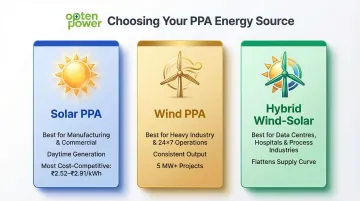
The choice of energy source depends on your load profile and consumption hours. Each option has distinct trade-offs:
| Source | Best For | Key Consideration |
|---|---|---|
| Solar | Manufacturing, commercial facilities | Predictable daytime generation; most cost-competitive |
| Wind | Heavy industry, 24x7 operations | Consistent output; projects typically 5 MW+ |
| Hybrid wind-solar | Data centres, hospitals, process industries | Combines daytime solar with nighttime wind; flattens supply curve |
Step-by-Step: How to Execute a PPA in Pune
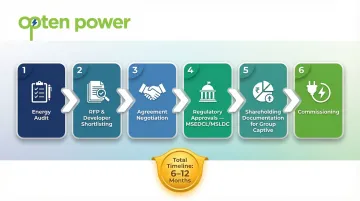
Step 1 — Energy audit and requirement mapping
Assess your annual consumption, load profile, contracted demand, and open access eligibility. Determine whether you need on-site rooftop capacity, off-site open access supply, or a group captive arrangement.
Step 2 — RFP creation and developer shortlisting
Issue a Request for Proposal to renewable developers. Evaluate bids on:
- Tariff competitiveness
- Developer track record and financial stability
- Plant location and wheeling logistics
- Technology and equipment quality
- Contract terms and flexibility
Comparing bids manually across multiple developers is time-consuming. Opten Power's marketplace lets Pune businesses review live tariff quotes from developers across 4+ GW of solar, wind, and hybrid capacity simultaneously — with automated RFP tools and pre-approved contract templates that compress the shortlisting phase significantly.
Step 3 — Agreement negotiation and regulatory approvals
Finalize PPA terms covering tariff, tenure, escalation, and exit clauses. Then work through the regulatory sequence:
- Submit open access applications to MSEDCL and MSLDC (Maharashtra State Load Despatch Centre)
- For group captive schemes, complete shareholding documentation confirming 26% ownership and 51% collective consumption compliance
- Obtain connectivity and metering approvals
Typical timelines run 4–6 months from application to regulatory approval, with full project commissioning in 6–12 months depending on plant type and location.
PPA Costs, Tariffs, and Savings: What to Expect in Maharashtra
Current Solar PPA Tariffs in Maharashtra
Recent competitive bidding and SECI/NHPC tenders in Maharashtra have established solar PPA tariffs in the following ranges:
- Utility-scale solar (ISTS/intra-state): ₹2.52–₹2.91/kWh
- Rooftop solar (generic tariff FY 2026-27): ₹2.82/kWh
These base tariffs are significantly lower than prevailing grid rates.
Open Access Charges for Third-Party PPAs
For third-party open access procurement (not group captive), Maharashtra's applicable charges for FY 2024-25 are:
| Charge | Rate |
|---|---|
| Wheeling | ₹0.60/kVAh |
| Transmission (short-term) | ₹0.48/kVAh |
| Cross-subsidy surcharge (CSS) | ₹1.79/kVAh |
| Additional surcharge | ₹1.36/kVAh |
Total open access add-on: ~₹3.23/kVAh above the base PPA tariff. (kVAh accounting is standard for open access charges in Maharashtra; base PPA tariffs are typically quoted in kWh.)
Net Savings Example
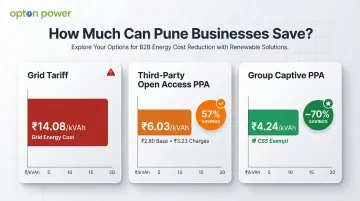
Scenario: HT commercial consumer paying ₹14.08/kVAh grid tariff.
- Grid cost: ₹14.08/kVAh
- Third-party open access landed cost: ₹2.80 (base PPA) + ₹3.23 (charges) = ₹6.03/kVAh
- Savings: ₹8.05/kVAh or approximately 57%
Group captive scenario: Exemption from CSS (₹1.79/kVAh) reduces landed cost to approximately ₹4.24/kVAh, yielding savings of nearly 70%.
How Contract Duration Affects Savings
Tenure length directly shapes your per-unit cost and flexibility:
| Tenure | Trade-off |
|---|---|
| 15–25 years | Lower fixed tariff; strong protection against future grid rate increases |
| 10–15 years | Higher per-unit rate; easier exit and better alignment with uncertain facility plans |
Businesses with stable, long-horizon operations — manufacturing plants, data centres, IT parks — typically capture the most value from longer tenures.
Frequently Asked Questions
What is PPA in renewable energy?
A PPA (Power Purchase Agreement) is a long-term contract between a renewable energy developer and a business. The developer builds and operates the plant; you pay only for the electricity consumed with no upfront capital investment.
What is the PPA rate for solar panels in India?
Solar PPA tariffs in India currently range between ₹2.5–₹4.5/kWh depending on state, plant type (rooftop vs. open access), contract tenure, and applicable charges. In Maharashtra, recent utility-scale solar tariffs have been approved at ₹2.52–₹2.91/kWh. Always verify current MERC orders or recent tenders for up-to-date rates.
What types of renewable energy PPAs are available for Pune businesses?
Three main models are available: on-site rooftop PPAs (zero capex, limited by roof space), open access off-site PPAs (utility-scale, with wheeling charges), and group captive schemes (minimum 26% equity, CSS exemption). The right fit depends on your load size, roof availability, and open access eligibility.
How long is a typical renewable energy PPA contract in India?
PPA tenures typically range from 10 to 25 years, with most C&I agreements structured for 15–20 years. Longer contracts usually offer lower fixed tariffs but require careful review of exit clauses and termination penalties.
What is open access in the context of solar PPAs in Maharashtra?
Open access lets eligible consumers (above 100 kW contracted load, aggregated if needed) buy power from third-party generators via the state transmission network instead of relying solely on MSEDCL. Applicable charges include wheeling, transmission, CSS, and additional surcharge as approved by MERC.
Who are the major renewable energy PPA providers serving Pune?
Active developers in Maharashtra's C&I PPA space include Tata Power Renewable Energy, Sunsure Energy, Cleantech Solar, and Hinduja Renewables. Pune businesses can compare multiple developers through Opten Power, a marketplace offering access to 4+ GW of capacity with real-time tariff comparison, IRR analysis, and automated contract execution.