Introduction
For steel, cement, textile, and chemical manufacturers in India, electricity isn't just an operating cost—it's one of the largest variables threatening margin stability. These plants run energy-intensive equipment continuously at high capacity, making power expenditure unavoidable and its cost directly tied to competitiveness. The industrial sector accounts for 42% of India's total electricity consumption, creating enormous operational costs that directly impact profitability.
Three converging pressures are forcing manufacturers to rethink their energy strategy:
- Rising grid tariffs that steadily erode operating margins
- Renewable Purchase Obligation (RPO) mandates requiring defined percentages of renewable power
- ESG commitments driving Scope 2 emissions reduction for export-market compliance
Solar and wind are now the cheapest new sources of power in India—meaning the economic and environmental case for switching finally point in the same direction.
This article covers the major renewable energy options available for manufacturing plants, how to procure them, and practical strategies to solve the 24/7 reliability challenge—with a decision framework for choosing the right option.
Key Takeaways
- Solar delivers the lowest cost and fastest deployment for manufacturers with high daytime loads
- Hybrid solar+wind projects provide near-round-the-clock renewable coverage for 24/7 operations
- Corporate PPAs and Open Access are the most popular procurement routes for large Indian manufacturers
- Battery storage and load scheduling bridge the gap between variable generation and continuous production demands
- The right option depends on state-specific landed costs — not just headline tariffs
Why Large Manufacturing Plants Are Rethinking Their Energy Strategy
Industrial energy consumption operates at staggering scale. Energy-intensive sectors—bulk chemicals, steel, cement, rubber processing—rely heavily on fossil fuel-based grid power for both electricity and process heat. With industrial facilities consuming 42% of India's total electricity, even marginal tariff increases translate to millions in additional operating costs.
Three forces are driving manufacturers toward renewables:
- Grid tariff costs at 10–15 INR/unit or higher directly compress margins — at that scale, even ₹0.50 saved per unit adds up to crore-level savings annually
- RPO compliance requires large consumers to source defined percentages from renewables; non-compliance triggers penalties that raise energy costs without delivering actual power
- Sustainability mandates — ESG reporting, export-market compliance, Scope 2 targets — have become procurement requirements for manufacturers in global supply chains
Solar and wind tariffs in India have fallen below ₹2.50/unit in recent competitive bids — well below prevailing industrial grid rates. For most large manufacturers, switching to renewables is now a cost decision first, and a sustainability decision second.
Top Renewable Energy Options for Large-Scale Manufacturing Plants
Solar Power (Rooftop and Ground-Mounted)
Solar PV is the most widely deployed renewable option for manufacturers. Two configurations dominate:
Rooftop solar offsets daytime loads without requiring additional land. Ideal for facilities with available roof space and consumption patterns that align with solar generation hours (typically 9 AM to 5 PM). Textiles, auto components, and food processing plants with predominantly daytime operations benefit most.
Ground-mounted captive solar parks deliver larger MW capacities on dedicated land. These installations suit manufacturers with available land parcels near their facilities and consumption exceeding rooftop capacity limits.
Solar's core advantages for manufacturers:
- Predictable generation aligned with business hours
- Payback periods of 3-4 years — fastest among renewable options
- Lowest per-unit cost of any renewable source
- Mature technology with short installation timelines and accessible financing
Wind Power
Wind turbines suit manufacturing plants in high-wind states including Tamil Nadu, Rajasthan, Gujarat, and Karnataka. Utility-scale wind procurement delivers consistent generation ideal for base load requirements, particularly for facilities with 24/7 operations.
Wind generation often peaks during evening and nighttime hours, complementing solar's daytime profile. Manufacturers running multiple shifts or continuous processes get the most out of wind's off-peak generation profile.
Wind projects typically require minimum capacities exceeding 5 MW and are best suited for heavy industries like steel, cement, and textiles with substantial round-the-clock power demand.
Hybrid Solar + Wind
Hybrid projects combine both resources on shared evacuation infrastructure, reducing intermittency and improving overall plant load factor. This configuration delivers near-round-the-clock renewable power by pairing solar's daytime peak with wind's nighttime generation.
For heavy industries operating 24/7—steel mills, cement plants, chemical processors—hybrid projects offer the highest renewable utilization without relying solely on one variable source. Combining resources also enables better tariff negotiation with developers and reduces per-unit costs compared to standalone projects.
Biomass and Waste-to-Energy
Biomass power is ideal for manufacturing plants generating organic waste. Paper mills, sugar mills, and food processing units can combust or anaerobically digest waste to generate electricity and steam for process heat simultaneously.
Unlike solar and wind, biomass provides baseload power—stable, continuous generation unaffected by weather or time of day. Facilities needing firm generation and those sitting on organic waste streams get a dual benefit: reliable power and waste monetization.
Green Hydrogen (Emerging)
Green hydrogen represents a forward-looking option for the most energy-intensive industries like steel and fertilizers that cannot easily electrify high-temperature process heat. While still in early commercial stages in India, green hydrogen is gaining policy support and pilot project momentum. India's National Green Hydrogen Mission targets 5 MMT annual production by 2030 — manufacturers in hard-to-electrify sectors should begin assessing readiness now.
Renewable Energy Certificates (RECs)
RECs provide an indirect procurement route for manufacturers unable to install or contract physical renewable capacity immediately. Purchasing RECs allows RPO compliance and supports ESG reporting, though it delivers no actual cost savings on electricity bills. RECs serve compliance and reporting purposes — they do not reduce electricity costs.
Quick Comparison: Renewable Options at a Glance
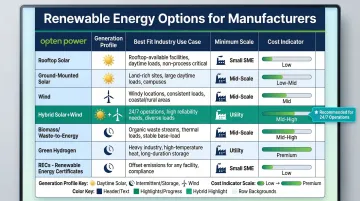
| Option | Generation Profile | Best Fit | Minimum Scale |
|---|---|---|---|
| Rooftop Solar | Daytime only | Daytime operations, limited land | ~100 kW |
| Ground-Mounted Solar | Daytime only | High consumption, available land | 1 MW+ |
| Wind | Evening/nighttime peak | 24/7 operations, high-wind states | 5 MW+ |
| Hybrid Solar + Wind | Near round-the-clock | Heavy industry, continuous processes | 5 MW+ |
| Biomass / Waste-to-Energy | Baseload (24/7) | Organic waste generators | Varies |
| Green Hydrogen | Emerging / flexible | Steel, fertilizers, high-temp heat | Pilot stage |
| RECs | N/A (indirect) | Compliance, ESG reporting | No minimum |
How Manufacturing Plants Can Procure Renewable Energy
Captive Power Plants (CPP)
The captive model involves directly owning or co-owning a renewable power plant. Key advantages include:
- Full control over generation and operations
- Low per-unit cost over the asset lifecycle (typically 25 years)
- Eligibility for concessional banking and wheeling charges
- Depreciation and tax benefits
The trade-off is upfront capital commitment and minimum ownership thresholds required under Indian regulations. Captive plants suit large enterprises with long investment horizons and balance sheets capable of absorbing capital deployment.
Open Access (Third-Party Sale)
Open Access procurement means purchasing renewable power from a third-party developer through the state grid via Short-Term or Long-Term Open Access agreements. This avoids ownership capex while still delivering below-grid tariffs.
State-specific DISCOM charges are where savings projections get complicated. These vary significantly by state and directly determine your landed cost:
- Wheeling charges: Fees for using the state transmission network
- Cross-subsidy surcharges: Levied by DISCOMs to protect their revenue base
- Transmission losses: Applied as a percentage of units wheeled
Headline tariffs alone don't reflect true savings. The actual cost depends on which state you're in and what that state's current charge schedule looks like.
Corporate Power Purchase Agreements (PPAs)
Corporate PPAs come in two structures:
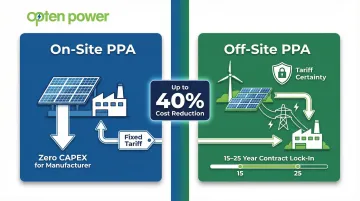
- On-site PPAs: The developer installs and owns the plant at your premises. You purchase power at a fixed tariff with zero capital outlay.
- Off-site PPAs: Power comes from a remote renewable project under a long-term contract (typically 15–25 years), locking in fixed tariffs and hedging against grid escalation.
Corporate PPAs can cut energy costs by up to 40% while providing tariff certainty over decades. Platforms like Opten Power enable manufacturers to compare live PPA offers across India's top developers, with instant IRR, payback, and regulatory analysis, which eliminates the need for sequential bilateral negotiations.
Group Captive
The Group Captive model allows multiple companies to co-invest in a renewable project, meeting the 26% equity and 51% consumption criteria under Indian electricity regulations. This structure is popular among mid-sized manufacturers wanting captive benefits without bearing full project costs alone.
Key advantages of the Group Captive structure include:
- Per-unit savings of ₹3–5 with strong IRRs
- Wheeling charge exemptions under captive regulations
- Shared capital burden across co-investors
- Often the fastest deployment timeline among ownership-based models
Approach to Comparison
Each of the four models above carries a different regulatory and cost profile depending on where your plant operates. That makes standardized, state-specific comparison essential before committing to any structure.
A valid comparison must factor in wheeling charges, banking rules, RPO credits, and developer tariffs simultaneously — not as separate calculations. Regulatory charges can erase apparent savings entirely when assessed in isolation.
Solving the 24/7 Power Challenge: Storage and Grid Integration
Manufacturing plants in steel, cement, and chemicals cannot afford power interruptions. Variable renewables—solar generates only during daylight; wind depends on weather—must be paired with strategies ensuring reliability.
Battery Energy Storage Systems (BESS)
Utility-scale battery storage can be co-located with renewable plants or installed behind the meter at factories. BESS stores surplus renewable generation and dispatches it during low generation periods or peak demand.
Battery storage costs in India have dropped sharply, with recent auctions clearing at INR 177,500/MW/month in Rajasthan, reflecting a 40% drop in turnkey costs driven by falling global battery prices and government Viability Gap Funding.
SECI is actively bundling BESS with renewable energy to provide firm power, with recent 1.2 GW/4.8 GWh renewables-plus-storage tenders clearing at INR 6.27/kWh.
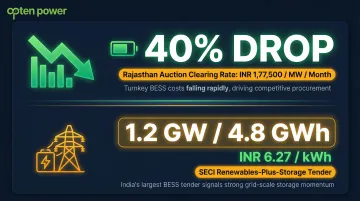
BESS is increasingly bundled into hybrid PPA contracts, shifting the reliability burden to the developer rather than the manufacturer.
Thermal Energy Storage and Industrial Heat Pumps
For manufacturers with significant process heating needs—rubber curing, chemical processing, pasteurization—thermal storage can store heat generated during peak renewable generation hours and use it when generation dips.
Industrial heat pumps can replace fossil-fuel-based process heat by running on renewable electricity, converting variable generation into stable thermal output. Key applications include:
- Process heating up to 150°C for chemical and food manufacturing
- Steam generation for rubber curing and textile processing
- Hot water systems for industrial washing and pasteurization
Demand Flexibility and Smart Manufacturing Controls
Demand flexibility shifts non-critical loads—compressed air systems, water pumping, material preprocessing—to times when renewable generation is abundant and tariffs are low.
Tools include:
- Variable-speed drives for motors and pumps
- Smart scheduling systems that align production with renewable availability
- Dynamic pricing programs leveraging time-of-use tariffs
State regulators like Maharashtra are revising Time-of-Day tariffs to offer rebates during solar hours (9 AM to 5 PM), incentivizing industrial consumers to shift loads to peak solar generation periods. For a steel or cement plant running multiple shifts, even modest load shifts can reduce monthly energy costs by 8–12%.
How to Choose the Right Renewable Energy Option for Your Plant
Use this four-factor decision framework:
Load Profile
Assess whether your plant runs 8 hours, 16 hours, or 24/7, and when peak consumption occurs. Plants with predominantly daytime operations suit solar PPAs. Facilities running continuous shifts need hybrid solar+wind or wind-heavy configurations.
Location
State-specific factors vary a great deal. Solar irradiation, wind speed, DISCOM policies, and Open Access regulations vary significantly across India's renewable-active states. A project that delivers 40% savings in Gujarat may deliver only 20% in Maharashtra due to regulatory charges.
Energy Intensity and Budget
Capex-heavy models like captive plants suit large, long-horizon operators with strong balance sheets. Off-balance-sheet PPAs suit those prioritizing opex certainty and avoiding capital deployment. Group Captive offers a middle path with minimal equity and maximum ROI.
Timeline
RPO compliance deadlines or ESG milestones may drive urgency toward faster-to-deploy options like off-site PPAs. Captive plants require longer development timelines but deliver greater long-term control.
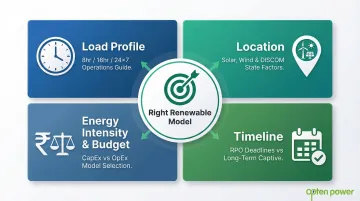
These four factors rarely point to a single obvious answer—most manufacturers end up evaluating options simultaneously across energy types, procurement models, states, and developers. Opten Power's marketplace consolidates that process, giving buyers access to 4+ GW of live renewable projects with real-time tariff and savings comparisons across developers, automated RFPs, and pre-approved contracts that cut deal timelines by 50%.
Headline tariff is not the same as landed cost. Any ROI assessment must account for regulatory charges, RPO credit value, and project reliability — those three variables routinely shift which option wins on actual savings.
Frequently Asked Questions
What is the cheapest renewable energy option for large-scale manufacturing plants?
Solar PV—especially captive or off-site PPA—is currently the lowest-cost renewable option for most Indian manufacturers. Actual landed cost depends on state-specific DISCOM charges, wheeling fees, and contract structure. Comparing standardized tariffs across multiple developers is essential before committing to any structure.
Can large-scale manufacturing plants run on renewable energy?
Yes, manufacturing plants can and do run on renewable energy. Achieving reliable coverage for 24/7 operations requires combining sources—hybrid solar+wind—paired with energy storage or demand flexibility strategies, rather than relying on a single renewable source alone.
What renewable energy options are available for large-scale manufacturing plants?
Primary options include captive solar, wind, hybrid solar+wind, biomass/waste-to-energy, and green hydrogen (emerging). Procurement routes include Open Access, Corporate PPAs, Group Captive, and RECs for compliance.
What is the most efficient renewable energy option for large-scale manufacturing plants?
Efficiency depends on load profile and location. Hybrid solar+wind with battery storage delivers the highest renewable utilization for 24/7 operations, while rooftop solar paired with a PPA suits plants with predominantly daytime loads by minimizing operational complexity.
What is a Corporate PPA and how does it work for manufacturers?
A Corporate PPA is a long-term agreement between a manufacturer and a renewable energy developer to supply power at a fixed tariff, either from an on-site installation or a remote off-site project. It provides cost predictability and shields against grid tariff escalation over 15-25 year terms.
How do manufacturing plants manage the variability of renewable energy?
Plants typically combine several approaches:
- Co-locating battery storage with renewable assets for round-the-clock supply
- Using thermal storage to meet process heat requirements
- Shifting non-critical loads to periods of peak renewable generation
- Structuring hybrid PPA contracts that bundle storage with generation