Introduction
HT industrial grid tariffs in Uttar Pradesh average ₹7.93/kWh — some of the highest in India. For manufacturers, steel plants, textile mills, data centres, and IT parks running high consumption loads, that cost compounds fast.
Green Energy Open Access is the regulatory mechanism that lets large commercial and industrial (C&I) consumers procure renewable electricity directly from generators, wheeling it across the grid for regulated charges instead of buying from the state DISCOMs.
With landed open access costs typically ranging ₹4.0–6.5/kWh, the savings gap is real and meaningful. This guide covers how green open access works end to end, what charges apply under current UPERC regulations, and where buyers most commonly go wrong.
Key Takeaways
- Green Energy Open Access lets C&I consumers in UP buy renewable power directly from generators instead of paying DISCOM tariffs
- Eligibility requires a contracted load of ≥100 kW under UPERC CRE Regulations 2024
- Charges beyond the PPA rate — wheeling, transmission, cross-subsidy surcharge, banking (8% for solar/wind), and demand charges — determine your actual landed cost
- UPERC's CRE Regulations 2024 lock in the open access framework through March 2029, giving C&I buyers a five-year planning window
- Landed costs range from ₹4.0–6.5/kWh versus grid tariffs exceeding ₹8–9/kWh for HT industrial consumers
What Is Green Energy Open Access in Uttar Pradesh?
Green Energy Open Access is a regulatory mechanism under the Electricity Act, 2003, operationalized in UP through UPERC's Open Access Regulations, 2019. It grants eligible consumers the right to use the state's transmission and distribution network to procure electricity from a renewable generator of their choice.
Instead of buying bundled power from the DISCOM, consumers pay regulated network access charges — keeping procurement flexible and cost-competitive.
The arrangement serves both sides of the transaction. The consumer locks in lower per-unit costs and long-term price predictability through a Power Purchase Agreement (PPA). The developer monetizes its capacity directly, without depending solely on state tenders.
Understanding where green open access fits among procurement options helps clarify the commitment involved. Three common models differ in ownership structure and delivery:
- Rooftop solar — behind-the-meter generation on the consumer's own premises
- Captive generation — the consumer holds an ownership stake in the generating project
- Green open access — a third-party arrangement where an independent developer owns and operates the plant; the consumer only procures power
Why C&I Industries in UP Are Switching to Green Open Access
The Cost Advantage
UP's industrial high-tension (HT) tariff makes grid power significantly more expensive than the landed cost achievable via a well-structured green open access PPA. UPERC's Tariff Order for FY 2024-25 sets the Average Billing Rate for HV-2 (Large and Heavy Power) consumers at ₹7.93/kWh. Landed open access costs, by contrast, range from ₹4.0–6.5/kWh. That gap is substantial enough to justify a serious financial evaluation for most large consumers.
Beyond Cost: Reliability and ESG Compliance
UP-specific conditions make open access attractive beyond just cost savings:
- High grid losses in distribution zones impact power quality and availability
- Power supply reliability concerns for 24×7 operations (steel, cement, data centres)
- Growing ESG and corporate sustainability reporting requirements push companies to demonstrate renewable energy procurement
SEBI's Business Responsibility and Sustainability Reporting (BRSR) framework mandates the top 1,000 listed entities to disclose energy consumption, Scope 1 and Scope 2 greenhouse gas emissions, and energy intensity. Procuring renewable energy via open access directly addresses Scope 2 emissions — which is where the regulatory environment in UP becomes relevant.
Regulatory Support
The UPERC CRE Regulations 2024 are structured to encourage, not restrict, green open access procurement:
- Explicitly permit third-party open access sales from solar projects
- Offer wheeling and transmission charge exemptions for qualifying capacities
- Align with the Uttar Pradesh Solar Energy Policy 2022
Together, these provisions give C&I buyers a stable regulatory foundation to commit to long-term PPAs with confidence.
How Green Energy Open Access Works in UP — End to End
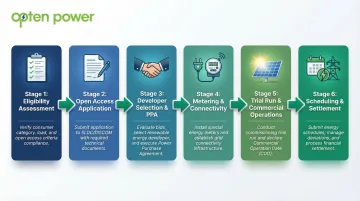
For C&I buyers, the open access journey in UP follows a defined sequence — each stage has distinct regulatory checkpoints and charge implications. The full path runs:
Eligibility assessment → Open access application → Developer selection & PPA → Metering & connectivity → Trial run & commercial operations → Ongoing scheduling and settlement
Step 1: Eligibility Check and Load Assessment
Under the UPERC CRE Regulations 2024, renewable generating plants of ≥100 kW are covered. Buyers should verify whether their contracted demand and consumption profile meets the short-term (up to one month), medium-term (1–5 years), or long-term (>5 years) open access categories, as procedural and charge implications differ.
Key considerations:
- Consumers with multiple connections may need to evaluate aggregation options
- Your load profile determines which procurement model suits you best
- Contract demand directly affects connectivity voltage level and charges
Step 2: Application for Open Access Approval
The consumer (or the developer on their behalf) submits an open access application to:
- UPPTCL (State Transmission Utility) for intra-state transmission system access, or
- Relevant DISCOM for distribution-level access
- ABT-compatible meters are mandatory — confirm meter specifications before submission
The State Load Despatch Centre (SLDC) handles scheduling confirmation. The UPPTCL First Amendment Regulations 2025 have updated procedural and connectivity requirements — review these before submitting.
Step 3: Developer Selection and PPA Execution
Once in-principle open access approval is obtained, the consumer evaluates competing renewable developers on:
- Generator tariff
- Escalation clauses
- Capacity offered
- Project location (affects wheeling distance and losses)
- PPA tenure (standard tenures of 7 or 12 years in UP)
Under UPERC CRE Regulations 2024, developers must not obtain multiple long-term open access approvals for the same project. When a DISCOM purchases power, PPA approval from UPERC is required — buyers should confirm UPERC approval status with their developer before signing.
Comparing developers across these criteria simultaneously can be time-intensive. Opten Power lets C&I buyers evaluate real-time tariffs and projected savings from multiple developers on one platform, with automated RFPs to accelerate deal closure.
Step 4: Metering, Connectivity, and Commercial Operations
Technical commissioning requirements under the CRE Regulations 2024:
Connectivity voltage levels by project capacity:
| Project Capacity | Required Voltage |
|---|---|
| Up to 4 MW | 11 kV |
| 4–20 MW | 33 kV |
- Developer bears evacuation facility costs up to the interconnection point
- Solar project must conduct a successful trial run at minimum 10% capacity (with an initial minimum of 5 MW) with SLDC verification before declaring commercial operation
- Wheeling and banking agreements are executed only after long-term open access is fully operational
Charges, Costs, and Energy Banking Rules You Must Know
Understanding the Full Landed Cost Stack
The landed cost is not just the generator tariff. It includes:
- Intra-state transmission charges
- Wheeling charges (DISCOM network)
- Cross-subsidy surcharge (CSS)
- Additional surcharge
- SLDC scheduling fees
- Banking charges (in energy terms)
- Demand charges
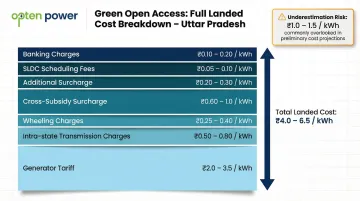
Buyers who focus only on the generator tariff routinely underestimate their actual landed cost by ₹1.0–1.5/kWh once all charges are applied.
Current Charges for FY 2024-25
Wheeling and Transmission Charges:
- Average wheeling charge: ₹1.012/kWh
- Intra-state transmission charge component: ₹0.268/kWh
Cross-Subsidy Surcharge (CSS) by Voltage Level:
| Supply Voltage | CSS (₹/kWh) | Distribution Loss |
|---|---|---|
| At 11 kV | ₹0.43 | 8.00% |
| Above 11 kV up to 66 kV | ₹0.49 | 3.00% |
| Above 66 kV up to 132 kV | ₹0.33 | 1.00% |
| Above 132 kV | ₹0.31 | 1.00% |
Connecting at higher voltages (66 kV and above) reduces both CSS and physical distribution losses.
Charge Exemptions Under CRE Regulations 2024
These charges are not fixed — CRE Regulations 2024 provide meaningful exemptions for larger solar projects that can directly offset the CSS figures above. Solar projects above 5 MW receive:
- 100% exemption from wheeling and transmission charges on sales to a DISCOM
- 50% exemption on sales to captive or third-party consumers
- 100% exemption from the additional surcharge on the intra-state transmission system
For a buyer's cost calculation, the 50% exemption on wheeling (₹1.012/kWh) and transmission charges can reduce the landed cost by approximately ₹0.50–0.60/kWh.
Energy Banking Rules in Detail
Banking allows buyers to store surplus generation with the grid and withdraw it later — but the rules around caps, charges, and timing directly affect how much of that stored energy is actually usable.
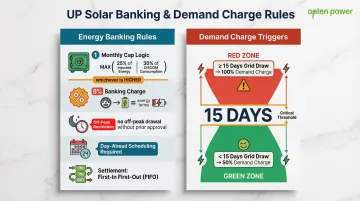
Monthly Caps:
- Banked energy per month capped at the higher of 25% of energy injected that month or 30% of the consumer's total monthly DISCOM consumption
Banking Charges:
- 8% in energy terms for solar, wind, and wind-solar hybrid projects
Withdrawal Rules:
- Energy banked in off-peak hours may only be withdrawn in off-peak hours
- Peak-hour banked energy can be withdrawn in either period
- All scheduling for banking and withdrawal is mandatory on a day-ahead basis
Settlement Method:
- First-In-First-Out (FIFO) basis
Demand Charge Implications
Captive buyers drawing DISCOM backup power alongside renewable generation are billed under the HV-2 tariff category. The number of days they draw from the DISCOM in a month determines the demand charge rate:
- 50% demand charge for up to 15 days' purchase in a month
- 100% demand charge if purchase exceeds 15 days
Exceeding 15 days triggers full demand charges, which can erode savings significantly. Buyers should model their DISCOM draw frequency before finalizing generation share targets.
Indicative Landed Cost Ranges
With all charge components accounted for, landed costs for UP range from approximately ₹4.0 to ₹6.5/kWh depending on:
- Project scale
- Distance from STU substation
- Voltage level
- Banking utilization
- PPA tenor
Always request a fully itemized landed cost sheet from developers, with each charge component listed separately — quoted generator tariffs rarely reflect what you'll actually pay.
UP's Regulatory Framework: UPERC Rules and 2024–25 Updates
Three-Layer Regulatory Structure
1. UPERC Open Access Regulations, 2019
The principal regulations establishing the framework for short-, medium-, and long-term open access, originally notified on December 10, 2019. The Commission notified the First Amendment on December 16, 2024, to align with the national Green Energy Open Access Rules.
2. UPERC Captive and Renewable Energy Generating Plants (CRE) Regulations, 2024
The notified comprehensive framework applicable April 2024 to March 2029, governing renewable and captive projects' commercial operation, banking, scheduling, metering, and PPA rules.
3. UPPTCL Open Access Regulation (First Amendment) 2025
Updating procedural, metering, and connectivity requirements, notified in February 2025.
What the CRE Regulations 2024 Change for Buyers
Compared to the previous framework, the CRE Regulations 2024 introduce:
- Banking cap: 25%/30% rule capping monthly banked energy
- Explicit wheeling/transmission charge exemption structure: 50% exemption for captive/third-party sales above 5 MW
- 5 MW minimum for trial run commissioning
- Limit of two wheeling and banking agreements per project lifetime
- Day-ahead scheduling mandate for projects above 5 MW
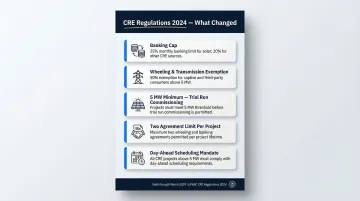
Buyers evaluating PPA proposals should model deviation and banking costs under the new caps before comparing landed tariffs.
Grid Discipline Obligations
The scheduling requirements tied to the CRE Regulations carry direct financial consequences for buyers. Solar and wind projects above 5 MW must comply with:
- Day-ahead scheduling
- Forecasting requirements
- Deviation settlement mechanisms via the SLDC
Poorly forecasted generation triggers deviation charges that erode savings — factor this into project due diligence. Small hydro and MSW-based plants are excluded from these requirements.
Current Regulatory Transition Risk
The 2024 draft Open Access Amendment was still at public consultation stage with stakeholder comments due. Verify the current notification status before finalising any procurement decision, and ensure PPA proposals include "change-in-law" clauses that protect against charge revisions mid-contract.
Recent CERC rulings confirm such clauses protect developers against tax hikes, though enforcement can be delayed by Supreme Court appeals.
Common Misconceptions About Green Open Access in UP
Misconception 1: "Open Access Power Is Just the Generator Tariff"
Reality: The full landed cost includes multiple regulated charges (wheeling, transmission, CSS, banking, demand) that can add ₹1.5–3.0/kWh on top of the base tariff. Buyers who only compare generator quotes without requesting an itemized landed cost sheet routinely underestimate total cost and face budget overruns.
Misconception 2: "Banked Energy Can Be Freely Withdrawn"
Reality: UP's CRE Regulations 2024:
- Cap monthly banking at 25%/30% of generation or DISCOM consumption (whichever is higher)
- Restrict off-peak banked energy to off-peak withdrawal only
- Require day-ahead scheduling of withdrawals
Ignoring these conditions leads to lapsed energy and lost value, particularly for consumers with intermittent or seasonal load patterns.
Misconception 3: "Green Open Access Works for Every Business"
When It May Not Be the Right Fit:
- Consumers with loads below 100 kW who cannot aggregate
- Facilities with poor grid connectivity facing high wheeling costs and long commissioning timelines
- Businesses with highly variable or short-term electricity needs where a 7–12 year PPA creates inflexibility
In these scenarios, alternatives such as group captive structures, rooftop solar, or power exchange purchases may offer better risk-adjusted economics.
A Forward-Looking Approach
Open access is a portfolio decision, not a one-time procurement event. Managing it well means staying active on three fronts:
- Monitor UPERC and UPPTCL notifications for regulatory changes affecting charges or banking rules
- Structure change-in-law protection clauses into PPAs before signing
- Track updated landing prices across developers and states as tariffs shift
Platforms like Opten Power's Real-Time Discom Intelligence dashboard consolidate this data in one place, so procurement decisions reflect current costs rather than outdated assumptions.
Frequently Asked Questions
What is the minimum load requirement for Green Energy Open Access in Uttar Pradesh?
The UPERC CRE Regulations 2024 set the threshold at ≥100 kW for renewable generating plants. Consumers below this threshold may need to explore group captive or aggregation arrangements to qualify.
What are the wheeling and transmission charges for open access solar power in UP?
For solar projects above 5 MW, the CRE Regulations 2024 provide 100% exemption from wheeling and transmission charges for DISCOM sales and 50% exemption for captive/third-party sales. As per current UPERC schedules, base wheeling charges are ₹1.012/kWh and transmission is ₹0.268/kWh before exemptions apply.
How does energy banking work for captive solar projects in Uttar Pradesh?
Energy banking is capped monthly at the higher of 25% of injected energy or 30% of DISCOM consumption, with an 8% banking charge in energy terms for solar/wind projects. Settlement follows a first-in, first-out (FIFO) method, and day-ahead scheduling is mandatory for withdrawals. Off-peak banked energy can only be withdrawn during off-peak hours.
What is the difference between captive open access and third-party open access in UP?
Captive open access requires the consumer to hold an ownership stake (≥26%) in the generating project and consume ≥51% of generation annually. Third-party open access involves a PPA with an independent developer who retains full ownership of the project. Captive models are 100% exempt from cross-subsidy surcharge.
How long does the open access approval process take in Uttar Pradesh?
Timelines depend on application type (short-, medium-, or long-term), SLDC and DISCOM/STU processing, and connectivity assessment. Most projects complete approval in 60–120 days, with metering and connectivity setup being the most common sources of delay.
Can a C&I consumer in Uttar Pradesh exit from a green open access arrangement mid-PPA?
Exit is governed by the PPA terms, typically involving termination fees or locked-in obligations for the 7–12 year contract period. Buyers must evaluate force majeure, change-in-law, and exit clauses carefully before signing long-term agreements to understand their obligations and exit costs.