Introduction
India's commercial and industrial (C&I) solar market is experiencing unprecedented growth. In 2024 alone, the country added a record 6.9 GW of solar open access capacity—a 77% year-over-year surge—bringing cumulative installed capacity in the open access segment to 20.2 GW.
CRISIL projects C&I renewable capacity will surge 40% to 57 GW by FY2028, making Power Purchase Agreements (PPAs) the primary mechanism through which Indian businesses are locking in long-term energy cost savings.
Yet many businesses struggle with a critical challenge: commercial solar PPA rates in India are not fixed. They vary dramatically across states, capacity sizes, PPA structures, and contract terms. Misunderstanding this complexity leads to poor negotiations, unfavourable escalation clauses, and missed savings opportunities—sometimes costing businesses 20-30% more than necessary over the life of the contract.
This guide covers the 2026 PPA rate ranges businesses should expect, the variables that push rates up or down, the cost components embedded in every tariff, and how to evaluate and negotiate the right deal.
Key Takeaways
- Entry-level (1 MW+, solar-rich states): ₹2.50–₹3.50/unit
- Mid-range (200 kW–1 MW): ₹3.50–₹4.50/unit
- Premium (smaller systems or high-charge states): ₹4.50–₹6.00/unit+
- Key rate drivers: State DISCOM tariffs, project scale, PPA term length, and regulatory model (on-site vs. open access vs. group captive)
- Lower rates favour: Large industrial consumers (steel, cement, textiles) with 1 MW+ capacity in Rajasthan, Gujarat, Andhra Pradesh
- Watch out: Per-unit rates alone mislead—landed costs can reach ₹8.4/kWh in Maharashtra once escalation and open access charges are added
What Are Commercial Solar PPA Rates? 2026 Pricing Overview
A commercial solar PPA rate is the per-unit price (₹/kWh) a business agrees to pay a solar developer for electricity over a fixed term (typically 15-25 years). Unlike purchasing solar equipment outright, a PPA is an energy service contract: the developer owns, operates, and maintains the solar plant, and you pay only for the power generated.
Misjudging PPA rates leads to costly pitfalls. Businesses lock into above-market contracts, overlook escalation traps, or choose the wrong PPA structure (on-site rooftop vs. third-party open access vs. group captive) for their load profile. The rate tiers below show what's realistic in 2026 — and what separates a competitive deal from an expensive one.
Typical PPA Rate Tiers in India (2026)
| Rate Tier | Typical Range | Project Scale | Best For |
|---|---|---|---|
| Competitive | ₹2.50 – ₹3.50/kWh | 1 MW+ ground-mounted or large rooftop | Steel, cement, textiles in Rajasthan, Gujarat, Andhra Pradesh |
| Mid-Range | ₹3.50 – ₹4.50/kWh | 200 kW – 1 MW, open access PPAs | Manufacturing, IT parks, warehouses, data centres |
| Premium | ₹4.50 – ₹6.00+/kWh | Smaller systems, hybrid/storage configs | Hospitals, hotels, commercial complexes in high-tariff states |
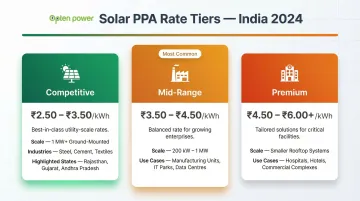
Competitive tier (₹2.50 – ₹3.50/kWh): These rates apply to large industrial consumers with 1 MW+ capacity needs in high-irradiance states. Contracts typically run 20-25 years with flat or low-escalation terms, with the developer bearing O&M costs. Utility-scale solar tenders in 2024-2025 cleared tariffs from ₹2.48 to ₹3.04/kWh, setting the floor for competitive C&I deals.
Mid-range tier (₹3.50 – ₹4.50/kWh): Common for mid-scale commercial systems using third-party open access, with moderate escalation clauses (1-2%). ISTS green open access solar tariffs typically sit between ₹3.00 and ₹3.50/kWh, with wind-solar hybrid projects ranging from ₹3.50 to ₹4.00/kWh.
Premium tier (₹4.50 – ₹6.00+/kWh): Driven by smaller system sizes, high wheeling or grid charges, storage components, or shorter contract durations. Smaller rooftop installations carry EPC costs of ₹40-55 million/MW versus ₹34-38 million/MW for utility-scale projects — a gap that flows directly into the PPA rate.
Key Factors That Affect Commercial Solar PPA Rates
PPA rates are shaped by a combination of geographic, regulatory, technical, and contractual variables. No two PPAs are priced identically, even for similarly sized businesses. Understanding what moves the needle helps you evaluate quotes critically and negotiate from an informed position.
State and DISCOM Tariff Landscape
A state's existing grid tariff—the benchmark a PPA displaces—and its open access policy directly determine how aggressively a developer can price a PPA. States with high grid tariffs enable lower effective PPA rates because the savings gap is larger.
FY 2025-26 grid tariff examples:
- Maharashtra (MSEDCL): HT II Commercial energy charge of ₹14.03/kVAh with demand charge of ₹600/kVA/month
- Andhra Pradesh: HT II Commercial (11kV) energy charge of ₹7.65/kVAh with demand charge of ₹475/kVA/month
- Telangana: HT II Commercial (11kV) energy charge of ₹8.50/kVAh with demand charge of ₹70/kW/month
Open access charges vary by state and can add ₹0.50–₹2.00/unit to the effective cost of third-party PPAs. These include:
- Wheeling charges
- Transmission charges
- Cross-subsidy surcharges (CSS)
- Additional surcharges (AS)
In Gujarat, for example, the additional surcharge increased by 22% from ₹0.82/kWh to ₹1/kWh as of March 31, 2026, pushing up landed costs for open access consumers.
Capacity and Scale of the Solar Plant
Larger projects command lower per-unit rates due to economies of scale in EPC costs, land acquisition, and financing. Utility-scale EPC costs have declined to ₹34-38 million per MW, while rooftop solar for C&I is priced higher at ₹40-55 million/MW due to import duties and advanced technologies like mono-PERC and bifacial modules.
These cost differences flow directly into the rates buyers see on their PPA term sheets.
Rate advantage by capacity:
- A 5 MW ground-mounted project typically secures rates ₹0.50–₹1.00/unit lower than a 200 kW rooftop installation
- 24x7 load-heavy operations — data centres, process industries — get more competitive terms than seasonal or variable consumers
- Contracted demand and load factor both factor into a developer's revenue model, which in turn shapes their pricing floor
PPA Term and Escalation Clause
Longer PPA terms (20-25 years) typically yield lower starting rates because the developer has greater revenue certainty for project financing. Shorter terms or flexible exit clauses increase the rate to compensate for higher financing risk.
Escalation clauses are where many buyers get surprised. A headline rate that looks attractive at signing can quietly outpace a higher flat rate once compounding takes hold.
Illustrative comparison:
- Flat-rate PPA: ₹4.00/unit for 20 years = ₹4.00 average rate
- Escalating PPA: ₹3.50/unit with 2% annual escalation = ₹4.28 average rate over 20 years
- Escalating PPA: ₹3.50/unit with 3% annual escalation = ₹4.71 average rate over 20 years
At 3% escalation, that ₹3.50 starting rate effectively costs more than a ₹4.50 flat-rate contract by year 15 — always model the full 20-year spend, not just the opening number.
PPA Structure and Regulatory Model
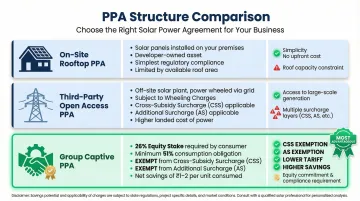
India's C&I solar market offers three main PPA structures, each with different pricing, tax treatment, and compliance requirements:
On-site rooftop PPA (developer-owned):
- Solar panels installed on your premises
- Developer owns and maintains the system
- Simplest regulatory compliance
- Limited by available roof space
Third-party open access PPA (off-site, wheeled power):
- Power sourced from an off-site solar plant
- Electricity wheeled through the grid
- Subject to wheeling, transmission, CSS, and AS charges
- Requires compliance with state open access regulations
Group captive PPA (26% equity stake model):
- Requires captive users to hold minimum 26% equity ownership in the project
- Must consume at least 51% of electricity generated
- Exempt from CSS and Additional Surcharge, saving ₹1–2/unit over third-party routes
- Lowest effective rates available, but requires upfront capital commitment
- Best suited for large enterprises with predictable, high-volume consumption
Group captive structures remain the most lucrative procurement route, bypassing hefty surcharges that can add ₹1-2/unit to third-party open access arrangements.
What Goes Into a Commercial Solar PPA Rate? Cost Components Decoded
A commercial solar PPA rate bundles several distinct cost components into a single per-unit figure. Knowing what each component covers is where the negotiation leverage actually sits.
Solar generation tariff (base component):
- Covers developer's capital recovery, O&M cost, financing cost, and return on equity
- Most influenced by module prices, capacity factor, and location
- Global solar module prices hit record lows of $0.096/W in late 2024, but Indian C&I PPA tariffs have not dropped proportionally due to the Approved List of Models and Manufacturers (ALMM) mandate and Domestic Content Requirements (DCR)
Open access and regulatory charges (for third-party PPAs):
- Wheeling charges, transmission charges, scheduling and forecasting charges, cross-subsidy surcharges
- State-determined and non-negotiable
- Businesses that exclude these from their cost model routinely underestimate their effective per-unit rate
- Can add ₹0.50–₹2.00/unit depending on the state
Escalation clause (recurring impact):
The math here trips up more buyers than any other clause. Consider two scenarios for 1 million units consumed over 20 years:
| Structure | Starting Rate | Total Cost (20 years) |
|---|---|---|
| Flat rate | ₹4.00/unit | ₹80 lakh |
| Escalating rate | ₹3.50/unit + 2% p.a. | ₹85.6 lakh |
The lower headline rate costs ₹5.6 lakh more. A 2% annual escalation compounded over 20 years increases the effective rate by roughly 20–25%.
Beyond the contract structure, the developer's own risk profile shapes the rate directly.
Risk and service margin:
- Developer margin for performance guarantees, insurance, and project risk
- Runs lower for established IPPs with large portfolios
- Higher for new or smaller developers with less operational track record
Ancillary charges:
- Metering and billing systems
- Renewable Energy Certificate (REC) costs for projects where RECs are not bundled into the tariff
- Grid balancing charges depending on state regulations
Low-Rate vs. High-Rate Commercial Solar PPAs — What's the Real Difference?
The gap between a ₹2.80/unit PPA and a ₹4.50/unit PPA reflects real differences in developer quality, contract flexibility, and long-term risk — not just pricing.
| Dimension | Low-Rate PPA (₹2.50-₹3.50/unit) | High-Rate PPA (₹4.50-₹6.00/unit) |
|---|---|---|
| Starting Rate | Competitive, large-scale economies | Higher due to smaller scale or premium features |
| Escalation Structure | Often includes 1.5-3% annual escalation | May offer flat rates or lower escalation |
| O&M Responsibility | Developer manages with proven track record | Developer manages, but quality varies |
| Developer Stability | Established IPPs with multi-GW portfolios | May include newer or smaller developers |
| Performance Guarantee | Strong guarantees (typically 80-90% over 25 years) | Variable, depends on developer |
| Exit/Renegotiation Options | Limited flexibility, locked for 20-25 years | May offer buyout or review clauses |
| Regulatory Compliance Support | Comprehensive support for open access compliance | May require buyer to manage compliance |
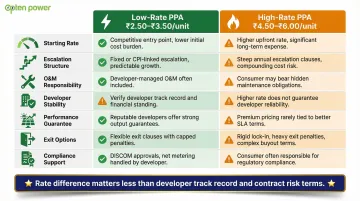
A low-rate PPA from a poorly capitalised developer — especially in states with complex open access rules — can carry costs that don't appear in the headline tariff. Watch for:
- Project delays caused by weak balance sheets or incomplete land acquisition
- Generation shortfalls where under-maintained plants produce 15-20% below contracted output
- Developer exit risk where smaller IPPs wind down operations before the 25-year term ends
- Compliance gaps leaving the buyer responsible for DISCOM approvals and open access filings
The rate difference matters far less than the developer's track record and the contract's risk-sharing terms.
How to Evaluate and Secure the Right Commercial Solar PPA Rate
The right PPA rate depends not just on the lowest ₹/unit figure but on a complete evaluation: your load profile, state-specific charges, developer track record, and contract terms.
Key evaluation checklist:
- Benchmark against current DISCOM tariffs for your location and consumption category
- Calculate total 20-year cost including escalation and all open access charges (wheeling, CSS, AS)
- Verify developer O&M commitment through references, portfolio size, and operational track record
- Assess open access policy risk — surcharge changes, banking policies, and deemed generation clauses vary significantly by state
- Compare PPA structures (on-site vs. open access vs. group captive) based on your capital availability and risk appetite
- Review contract terms for performance guarantees, exit clauses, and dispute resolution mechanisms
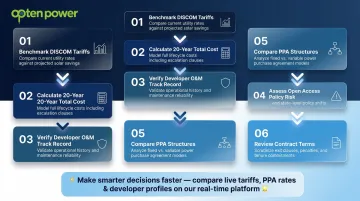
Running through this checklist manually across multiple developers and states is time-intensive. Platforms like Opten Power consolidate this process — comparing live PPA tariffs, DISCOM landed costs, and developer offerings across 16 states in one place. With access to 4+ GW of renewable capacity and real-time escalation analysis, businesses can shortlist developers and lock in competitive rates faster.
What Most Businesses Get Wrong About Commercial Solar PPA Rates
Mistake 1: Focusing Only on the Headline ₹/Unit Rate
Many businesses compare PPA offers based solely on the quoted tariff without accounting for escalation clauses, open access charges, and compliance costs. The fully-loaded landed cost per unit can be 20-30% higher than the quoted tariff for third-party open access arrangements. In Q4 2025, net landed open access costs ranged from under ₹5/kWh to ₹8.4/kWh across states, with Maharashtra reporting the highest landed cost.
Mistake 2: Choosing the Lowest-Bidding Developer Without Checking Financial Stability
Solar plants are 20-25 year assets. A developer who exits midway or underdelivers on generation can cost you far more than the premium you'd pay for a reliable IPP. Before signing, verify:
- Portfolio size and operational track record
- Financial backing and creditworthiness
- O&M capabilities and response times
- Customer references and case studies
Mistake 3: Skipping Regulatory Due Diligence for Your State
Open access rules, deemed generation clauses, and banking policies differ dramatically across Indian states. Not understanding these before signing can result in unexpected charges or loss of the PPA's cost advantage. For example:
- In Punjab and Tamil Nadu, savings turned negative compared with the previous quarter due to rising open access charges and PPA tariffs
- Gujarat's additional surcharge increased by 22% from ₹0.82/kWh to ₹1/kWh as of March 31, 2026
State-level charges can quietly erase what looked like a strong deal on paper.
Frequently Asked Questions
What are typical commercial solar PPA rates?
Commercial solar PPA rates in India in 2026 range from ₹2.50–₹3.50/unit for large-scale projects in solar-rich states, ₹3.50–₹4.50/unit for mid-scale installations, and ₹4.50–₹6.00/unit or higher for smaller systems or high-charge states. Rates vary by state, capacity, and contract structure—always compare against your current DISCOM tariff for context.
What is a commercial PPA?
A commercial PPA (Power Purchase Agreement) is a contract where a solar developer owns and operates a solar plant, and a business agrees to purchase the electricity generated at a fixed per-unit rate over a multi-year term (typically 15–25 years). No upfront capital is required from the buyer.
How long is a typical commercial solar PPA contract in India?
Most commercial solar PPAs in India run for 15–25 years, with longer terms typically offering lower starting rates. Some contracts include review or buyout options at defined intervals (such as year 10 or 15), allowing businesses to renegotiate or exit under specific conditions.
What is the difference between a rooftop PPA and an open access PPA?
A rooftop PPA involves the developer installing solar panels on your premises, while an open access PPA sources power from an off-site solar plant wheeled through the grid. Open access PPAs involve additional state-specific charges including wheeling, transmission, and cross-subsidy surcharges, which can add ₹0.50–₹2.00/unit to the effective cost.
Can commercial solar PPA rates be negotiated?
Yes, PPA rates are negotiable. Key levers include contract term length, escalation clause (flat vs. annual increase), capacity size, and choice of developer. Benchmark rates across multiple developers before committing—platforms like Opten Power enable real-time comparison of tariffs and savings across 16 states.
Is a solar PPA better than buying solar panels outright for a commercial business?
A PPA requires zero capital and transfers operational risk to the developer, while outright ownership offers better long-term returns but demands upfront investment and O&M responsibility. The right choice depends on your capital position, risk appetite, and tax situation. Businesses with strong balance sheets and depreciation capacity often prefer ownership; those prioritising cash flow typically prefer PPAs.