Introduction
Grid tariffs for commercial and industrial (C&I) buyers have reached ₹7.48/kWh in Maharashtra and ₹7.50/kWh in Tamil Nadu as of FY2026—with some states seeing 15% annual escalations. For energy-intensive businesses, that trajectory is unsustainable.
Corporate Power Purchase Agreements (PPAs) offer a direct alternative: long-term bilateral contracts between C&I buyers and renewable energy developers, locking in fixed tariffs and bypassing DISCOM grid rates entirely. Rising energy costs, net-zero commitments, and expanding open access reforms are accelerating adoption across India's industrial sector.
This article covers the key market trends shaping corporate PPAs in India today—from hybrid project structures and open access policy shifts to evolving pricing dynamics and the industries driving demand.
Key Takeaways
- India's corporate PPA market is evolving from simple bilateral solar deals to complex hybrid, group captive, and round-the-clock contracts
- ESG mandates and Scope 2 reduction targets now drive demand alongside pure cost savings
- Navigating state-level open access policy variance is the single biggest barrier to scaling adoption
- Digital procurement platforms are cutting deal timelines and exposing pricing that was once negotiated in the dark
- Hybrid solar+wind+storage PPAs have become the go-to structure for industrial buyers needing 24x7 supply
5 Key Trends Shaping India's Corporate PPA Market
India's corporate PPA market is not monolithic—it is bifurcating by deal structure, buyer type, and state context. Here are the five trends defining its next phase.
Group Captive PPAs Are Going Mainstream
Group captive PPAs allow multiple C&I buyers to co-own a defined equity stake in a renewable project, enabling power offtake under more favourable wheeling and banking charge structures compared to third-party open access. Under the Electricity Act 2003 and Electricity Rules 2005, a project qualifies as captive only if captive users hold at least 26% ownership and consume at least 51% of generated electricity. The Supreme Court reaffirmed these thresholds in October 2023, providing regulatory clarity that shields group captive structures from Cross-Subsidy Surcharge (CSS) and Additional Surcharge (AS).
Why adoption is accelerating:
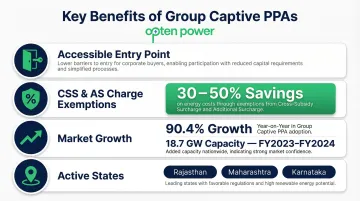
- Accessible entry point: Mid-sized companies typically priced out of large individual PPAs can now pool resources and share costs
- Massive charge exemptions: Group captive structures are exempt from CSS and AS, delivering 30-50% savings on energy bills
- Rapid growth: India's C&I open access market grew 90.4% between FY2023 and FY2024, reaching 18.7 GW cumulative capacity
- Strong state presence: Group captive projects are particularly active in Rajasthan, Maharashtra, and Karnataka—states with robust open access frameworks
For instance, LG Electronics India signed a 9.8 MWp group captive solar PPA with Hinduja Renewables in 2025, explicitly targeting its RE100 commitment to achieve 100% renewable energy. Digital marketplaces are simplifying group captive structuring considerably, giving mid-sized buyers access to pre-vetted developers, standardised contract templates, and transparent DISCOM pricing without months of bilateral outreach.
Hybrid and Round-the-Clock (RTC) Power Contracts on the Rise
The shift from single-technology PPAs (pure solar or wind) to hybrid solar+wind and co-located storage PPAs is driven by the need to address intermittency and meet continuous load requirements of 24x7 industries like steel, cement, and data centres.
Market signals:
- Global momentum: 5.8 GW of co-located and hybrid deals were tracked globally in 2025
- SECI benchmarks: India's 630 MW Firm and Dispatchable Renewable Energy (FDRE) auction cleared at tariffs of ₹4.98–₹4.99/kWh in March 2025
- Data centre demand: India's data centre capacity is expected to grow to 9 GW by 2030, consuming ~3% of India's electricity
Notable 2025-2026 RTC deals:
- Hindustan Zinc: 530 MW RTC hybrid PPA with Serentica Renewables, replacing ~25% of coal power
- Hyundai Motor Group: 28 MW wind-solar hybrid PPA with Fourth Partner Energy across Tamil Nadu
- Chemplast Sanmar: 84.9 MW wind-solar hybrid group captive PPA with JSW Green Energy
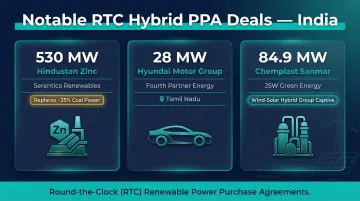
RTC supply is now a procurement prerequisite for heavy industries that require firm power, not variable generation tied to weather. With battery storage costs at $125/kWh (LCOS of $65/MWh), co-located solar+storage and hybrid PPAs have crossed the commercial viability threshold for continuous load operations.
ESG Mandates and Global Sustainability Commitments Driving Corporate Demand
Multinational subsidiaries and export-oriented Indian companies now face hard Scope 2 reduction targets. RE100 commitments, EU CSRD compliance requirements for supply chains, and SEBI's Business Responsibility and Sustainability Reporting (BRSR) framework all require documented renewable electricity procurement.
Regulatory drivers:
- SEBI BRSR Core: Mandates assured disclosure of Scope 1 and Scope 2 GHG emissions, including the percentage of energy consumed from renewable sources
- EU CSRD: Requires MNCs to assess and report on ESG performance of their supply chains, forcing Indian suppliers to demonstrate renewable procurement
- RE100 momentum: Over 15 Indian-headquartered companies are RE100 members, with 200+ international members reporting India operations
Corporate PPAs have moved from an energy cost lever to a compliance requirement for companies with global reporting obligations.
Examples of ESG-driven PPAs:
- Unilever: Brokered a 45 MW solar PPA in Rajasthan to supply 10 collaborative manufacturers, explicitly targeting Scope 3 emissions reductions
- Microsoft: Signed a 437.6 MW green attribute contract with ReNew, including a $15M community fund to support its 2030 carbon-negative goal
- Google: 150 MW solar PPA with ReNew in Rajasthan to address Scope 3 value chain emissions
Sustainability-linked financing instruments are creating financial incentives, beyond ethical considerations, for companies to sign renewable PPAs. PE/institutional investors in Indian companies now routinely include energy decarbonisation as a due diligence criterion.
Open Access Reforms Reshaping PPA Economics Across States
That investor scrutiny makes the right state selection critical. Wheeling charges, banking regulations, cross-subsidy surcharges, and DISCOM policies vary sharply across India's 16+ energy markets, making a PPA commercially viable in one state and economically unattractive in another.
Central reforms vs. state reality:
- GEOA Rules 2022: Lowered open access eligibility threshold from 1 MW to 100 kW
- State deviations: Karnataka introduced a ₹25,000/MW facilitation fee; Rajasthan imposed a Renewable Energy Development Fund levy
- CERC regulations: Facilitate non-discriminatory interstate transmission, though state-level DISCOMs deploy creative surcharges
State-by-state charge comparison:
| State | Cross-Subsidy Surcharge | Additional Surcharge | Banking Charge |
|---|---|---|---|
| Maharashtra | ₹1.79/kWh | ₹1.36/kVAh | 8% charge in kind |
| Rajasthan | ₹1.48/kWh | ₹0.50/kWh | Annual; max 25% injected energy |
| Gujarat | ₹1.29/kWh | ₹0.82/kWh | ₹1.50/kWh charge extended to June 2026 |
| Tamil Nadu | ₹1.99/kWh | Determined annually | Monthly; 8% charge in kind |
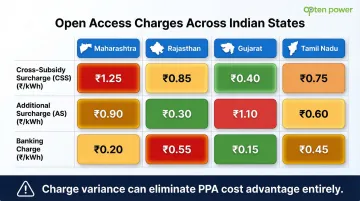
This regulatory variance creates real risk for long-term PPA planning. Corporates operating across multiple states need state-by-state regulatory intelligence before signing contracts — high CSS and AS rates can erase the cost advantage of renewable PPAs entirely.
Digital Marketplace Procurement Replacing Slow Bilateral Negotiations
Traditional bilateral PPA sourcing involves months of developer outreach, manual RFP management, opaque tariff benchmarking, and lengthy legal negotiations. Digital platforms are replacing this with centralised developer access, standardised contract terms, and real-time tariff comparison.
How digital platforms compress timelines:
- Automated RFPs: Structured bid collection from multiple developers with automated evaluation
- Standardised contracts: Pre-approved, modular PPA templates cut negotiation time significantly
- Real-time tariff comparison: Transparent pricing intelligence across developers and states
Platforms like Opten Power address this directly by providing access to 4+ GW of renewable capacity across 16 states, real-time DISCOM landing price intelligence, and automated RFP tools that compress deal timelines by up to 50%. This trend lowers the barrier to PPA adoption for mid-sized enterprises previously locked out by complexity and resource constraints.
What's Driving These Corporate PPA Trends in India
Several converging forces are reshaping how India's C&I sector procures energy — from widening cost gaps to tightening compliance obligations and shifting investor expectations.
Cost arbitrage vs. grid tariffs:
With HT industrial grid tariffs reaching ₹7.48/kWh in Maharashtra and ₹7.50/kWh in Tamil Nadu (FY2026), renewable PPA tariffs of ₹4.98–₹4.99/kWh for firm power present compelling cost arbitrage. In some regions, grid tariffs have escalated by up to 15% annually, while long-term PPAs offer price certainty. As the cost gap widens, the financial case for PPAs becomes harder to ignore for energy-intensive industries where energy represents 15–40% of operating costs.
India's 500 GW renewable target by 2030:
India targets 500 GW of non-fossil fuel capacity by 2030. As of March 31, 2026, installed renewable capacity stood at 274.68 GW. This national ambition — combined with corporate RPO (Renewable Purchase Obligation) compliance requirements — is creating both supply-side developer activity and demand-side regulatory pressure on large consumers.
The Ministry of Power's October 2023 notification set the total renewable energy target at 43.33% by 2029-30, with shortfalls penalised under the Energy Conservation Act.
Grid tariff volatility and fossil fuel price exposure:
Grid power tariffs have seen consistent upward revision driven by fossil fuel price volatility and DISCOM financial stress. Long-term PPAs offer price certainty over 10–25 years, allowing CFOs to model energy costs with precision and hedge against future escalations. This predictability is particularly valuable for project finance and long-term capital planning.
Regulatory enablers and barriers:
Central reforms — including GEOA Rules and CERC's open access regulations — create a more enabling environment, but inconsistent state-level implementation by DISCOMs introduces execution risk. State-level restrictions vary significantly across three key dimensions:
- Cross-Subsidy Surcharge (CSS): Rates differ by state, directly affecting landed PPA costs
- Additional Surcharge (AS): Applied inconsistently, sometimes eliminating cost arbitrage in certain states
- Banking restrictions: Limits on surplus energy banking reduce flexibility for variable-load consumers
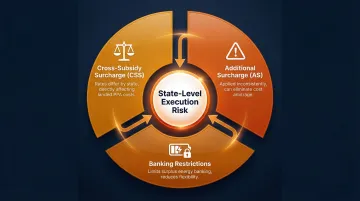
Navigating these variations is often what separates a viable PPA deal from a stalled one.
ESG investor and supply chain pressure:
PE/institutional investors in Indian companies now routinely include energy decarbonisation as due diligence criteria. SEBI's framework for ESG Debt Securities (June 2025) requires independent third-party reviewers and predefined Sustainability Performance Targets (SPTs), creating a financial incentive for renewable procurement. Sustainability-linked financing instruments directly link borrowing costs to renewable energy adoption.
How These Trends Are Impacting Indian Businesses
Energy Cost Certainty Changes Planning
Locking in long-term PPA tariffs allows CFOs and operations teams to model energy costs over 10–25 years, reducing exposure to annual DISCOM tariff revisions. This matters most for industries where energy represents 15–40% of operating costs. Tata Steel's 966 MW renewable energy PPA with Tata Power — supplying 2.8 lakh MWh and 4.2 lakh MWh to its Jamshedpur and Kalinganagar plants in FY2025-26 — shows what cost predictability at scale looks like.
Energy Procurement Moves to the Boardroom
Corporate PPAs are no longer a procurement team decision. They now intersect with ESG strategy, investor relations, and supply chain management. At large Indian conglomerates, energy procurement is shifting from operational departments to executive strategy teams — driven by the dual mandate of cutting costs while meeting sustainability commitments that investors, regulators, and customers increasingly expect.
Heavy Industries and Data Centres Lead Adoption
Steel, cement, fertilisers, textiles, and data centres are the most active C&I PPA segments due to high load factors and continuous energy demand. These sectors represent a 20 GW open access solar market opportunity. Princeton Digital Group's partnership with Tata Power Renewables and Flexidao to implement time-matched, hourly carbon-free energy (CFE) at its 150 MW Mumbai data centre shows how advanced renewable procurement has become in this segment.

Managing New Risks
The same trends creating PPA opportunities also introduce real complexity. Key risks include:
- Regulatory change risk from shifting state-level open access policies
- Curtailment risk when grid constraints reduce actual generation
- Offtake volume variability as business energy demand fluctuates
Companies must manage these through contract structuring, developer due diligence, and state-level regulatory analysis. Platforms with real-time DISCOM intelligence and automated regulatory impact analysis — like Opten Power — reduce this burden significantly.
Future Signals for Corporate PPAs in India
Battery Storage at Scale Will Unlock True 24x7 Renewable Supply
Battery storage costs are declining fast—global benchmarks now sit around USD $125/kWh for long-duration utility-scale systems, with a levelised cost of storage (LCOS) near USD $65/MWh. At these levels, co-located solar+storage and hybrid PPAs become commercially viable for continuous load industries.
This resolves the intermittency problem that has held back many heavy industries. Steel plants, cement facilities, and process industries requiring firm baseload power can procure renewable energy without compromising on reliability or cost.
GHG Protocol Hourly Matching Will Tighten Renewable Claims
Proposed GHG Protocol updates—currently under public consultation (October 2025–January 2026)—would require organisations to match contractual instruments to electricity consumption on an hourly basis, replacing annual accounting. For Indian corporate buyers, this means:
- Time-matched RECs rather than annual certificates
- Storage-backed contracts to cover non-generation hours
- More granular energy reporting and disclosure
Princeton Digital Group's hourly carbon-free energy (CFE) matching at its Mumbai data centre is an early indicator of where the market is heading. Deal structures will grow more complex, but renewable claims will become far more credible.
Carbon Markets Will Add a Financial Layer to PPA Strategy
India's Carbon Credit Trading Scheme (CCTS)—amended in December 2023 to introduce an offset mechanism—now allows non-obligated entities to register projects for GHG emission reduction and seek issuance of Carbon Credit Certificates (CCCs).
Combined with the existing REC framework, this gives PPA offtakers a new financial dimension: the ability to monetise or retire carbon assets alongside energy savings. Companies can stack revenue streams, meet compliance targets, and strengthen ESG disclosures from a single renewable procurement contract.
Conclusion
India's corporate PPA market is shifting from a cost-reduction tool used by a handful of large industries to a multi-dimensional strategic instrument driven by ESG mandates, regulatory reform, hybrid technology, and digital procurement. With grid tariffs escalating 15% annually in some regions and renewable PPA tariffs delivering 30-40% cost arbitrage, companies that act now lock in both cost and compliance advantages simultaneously.
As group captive structures go mainstream, hybrid RTC contracts become standard, and ESG reporting requirements tighten, the window for differentiation is narrowing. Building renewable procurement capabilities now means carrying a structural cost advantage into the next decade. Three priorities stand out for companies getting started:
- Navigate open access regulations early — state-level rules vary significantly and delay first-timers
- Select contract structures that match load profiles (RTC hybrid vs. fixed-hour solar)
- Use competitive procurement platforms to benchmark developer tariffs before signing
Companies that get these fundamentals right won't just meet compliance targets — they'll outperform peers on energy costs for years to come.
Frequently Asked Questions
What are the different types of corporate PPAs?
India's main structures span four models, each with distinct regulatory treatment and cost implications:
- On-site (rooftop/captive): Power generated and consumed at the same premises
- Off-site open access: Power wheeled from a remote plant via transmission networks
- Group captive: Multiple buyers co-own equity in a shared project
- Sleeved PPA: A DISCOM intermediates the supply arrangement
Open access charges like cross-subsidy surcharges (CSS) and additional surcharges (AS) apply differently to each.
What is the difference between a merchant PPA and a corporate PPA?
A merchant PPA sells power into the open market at prevailing spot prices, carrying price risk. A corporate PPA is a long-term bilateral contract with a specific offtaker at a pre-agreed fixed or indexed tariff, providing price certainty to both developer and buyer.
What is the difference between a corporate PPA and a virtual PPA?
A physical corporate PPA involves actual electricity delivery to the buyer's premises (or via open access). A virtual (or financial) PPA is a contract-for-difference where the buyer settles the tariff difference financially without taking physical delivery. Virtual PPAs are common in the US/Europe but remain rare in India's current regulatory framework.
What is the typical contract tenure for a corporate PPA in India?
Corporate PPAs in India typically run for 10–25 years for utility-scale projects, though shorter tenures of 5–10 years are emerging for captive and group captive structures. Longer tenures generally secure lower tariffs and improve bankability for project financing.
Which sectors in India are most active in signing corporate PPAs?
Steel, cement, fertilisers, textiles, data centres, IT parks, and manufacturing lead adoption — driven by high, consistent energy loads that make long-term PPA economics viable. Together, these segments represent a 20 GW open access solar market opportunity.
How do open access charges affect corporate PPA economics in India?
Open access charges — wheeling, transmission, cross-subsidy surcharges (CSS), and DISCOM-imposed banking restrictions — vary widely by state and can erode the cost advantage of a renewable PPA. For instance, Tamil Nadu charges ₹1.99/kWh CSS while Gujarat charges ₹1.29/kWh—making state-level regulatory assessment essential before committing to any PPA structure.