Introduction
Gujarat leads India in renewable energy capacity with approximately 32,924 MW installed, accounting for roughly 15% of the nation's total RE capacity. Yet many commercial and industrial consumers, captive power plant operators, and open access buyers remain unclear on their exact obligations under the Gujarat Electricity Regulatory Commission's evolving procurement regulations — leaving them exposed to penalties of ₹3.72 per kWh for every unit of unmet obligation.
In 2025, GERC finalized sweeping new regulations that nearly double total Renewable Purchase Obligation (RPO) targets — from approximately 10% in FY 2017-18 to 43.33% by FY 2029-30. The 2025 framework also introduces an Energy Storage Obligation (ESO) starting at 1% and a first-ever Hydro Renewable Obligation for new projects.
Critically, the captive power plant threshold drops from 5 MW to 100 kW, vastly expanding the universe of obligated entities.
If you're determining whether your operations fall under these obligations — and how to meet them — this guide covers who is obligated, how RPO and ESO targets are structured through 2030, and what compliance pathways are available, including open access, RECs, and power purchase agreements.
Key Takeaways
- Distribution licensees, captive plants above 100 kW, and open access consumers all carry RPO obligations
- ESO starts at 1% in FY 2024-25 and rises to 3.5% by FY 2029-30
- Non-compliance penalty: ₹3.72 per kWh of unmet obligation
- Compliance options include PPAs, captive RE, RECs, and qualifying open access transactions
- Retail consumers supplied by DISCOMs are exempt unless they self-generate from conventional sources
What is GERC and Its Role in Gujarat's Renewable Energy Landscape
The Gujarat Electricity Regulatory Commission (GERC) is the state-level electricity regulator established under the Electricity Act, 2003. It exercises authority under Sections 61, 86(1)(e), and 181 to regulate tariffs, licensing, and renewable energy procurement across Gujarat.
Section 86(1)(e) is the pivotal provision — it mandates state commissions to "promote cogeneration and generation of electricity from renewable sources" and requires them to set a minimum percentage of total consumption that distribution licensees must procure from RE sources.
Authority is divided across three entities:
| Entity | Role |
|---|---|
| GERC (State Regulator) | Sets RPO percentages, determines compliance, adjudicates petitions, levies penalties |
| CERC (Central Regulator) | Governs national REC mechanism, issues certificate multipliers, operates central registry |
| GEDA (Gujarat Energy Development Agency) | Accredits RE generators, verifies generation data, monitors compliance for sub-1 MW entities |
GEDA serves as the operational link between CERC's national REC framework and GERC's state-level enforcement, managing the RPPO web portal where all compliance data is registered. Together, these three entities define the compliance environment every obligated entity in Gujarat must navigate.
Gujarat's Renewable Energy Leadership
Gujarat's installed renewable energy capacity reaches approximately 32,924 MW, representing roughly 15% of India's total RE capacity (which stood at 274,688 MW as of March 2026). The state ranks No. 1 in India for rooftop solar with over 3.36 lakh systems installed, contributing approximately 5,317 MW as of April 2025.
For industrial consumers across textiles, cement, steel, and process industries, this scale translates directly into compliance pressure: GERC's RPO targets are among India's most demanding, and non-compliance carries real penalty exposure. Understanding how the three-tier governance structure operates is the starting point for managing that obligation.
GERC RE Procurement Regulations: Evolution from 2010 to 2025
The 2010 Foundation
The GERC (Procurement of Energy from Renewable Sources) Regulations, 2010 (Notification No. 3 of 2010, dated April 17, 2010) established the original RPO framework. Initial targets for FY 2010-11 were:
- Wind: 4.5%
- Solar: 0.25%
- Biomass, Bagasse & Others: 0.25%
- Total: 5.0%
Obligated entities originally included distribution licensees and captive power plants of 5 MW and above. By FY 2012-13, targets increased to 7.0% total (Wind 5.5%, Solar 1.0%, Others 0.5%).
Amendments: 2014, 2018, and 2021
- First Amendment (2014): Notified March 3, 2014, substituted Table-I with revised RPO targets through FY 2016-17
- Second Amendment (2018): Introduced Table-II with escalated targets reaching 10.0% total RPO by FY 2017-18 (Wind 7.75%, Solar 1.75%, Others 0.50%)
- Third Amendment (2021): Further revised upward targets, building on the Table-II framework established in 2018
By 2021, rising renewable penetration and national grid integration pressures made a more comprehensive framework unavoidable.
The 2025 Regulations: A Comprehensive Transformation
The GERC Draft Regulations were published September 30, 2024 and went through formal public consultation — stakeholder feedback closed October 28, 2024, followed by a public hearing on November 12, 2024. The finalised framework was notified as GERC (Procurement of Energy from Renewable Sources) Regulations, 2025 (Notification No. 07 of 2025, dated August 8, 2025) and published in Gujarat Government Gazette Extraordinary No. 249 on August 12, 2025.
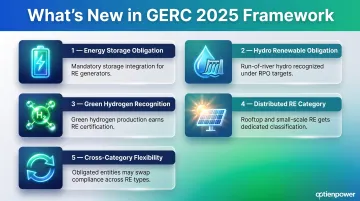
The 2025 framework introduces five changes that didn't exist under earlier regulations:
- Energy Storage Obligation (ESO): New obligation starting at 1% in FY 2024-25, rising to 3.5% by FY 2029-30
- Hydro Renewable Obligation (HRO): First-ever sub-category for hydro projects commissioned after March 31, 2024
- Green Hydrogen/Ammonia Recognition: RE consumed for green hydrogen/ammonia production counts toward RPO compliance
- Distributed RE Category: Separate sub-category for projects under 10 MW with dedicated annual targets
- Cross-Category Flexibility: Entities exceeding targets in one category (e.g., wind) can offset shortfalls in another (e.g., hydro or biomass)
These changes directly support India's 500 GW renewable energy target by 2030, while the ESO and cross-category flexibility provisions address a practical challenge that earlier regulations ignored: grid balancing as variable renewable generation rises. For C&I buyers and developers operating in Gujarat, the new framework creates both new compliance obligations and new procurement pathways.
Who Must Comply: Understanding Obligated Entities Under GERC
Three Categories of Obligated Entities
Under Regulation 3 of the 2025 framework, three entity types face RPO obligations:
- Distribution Licensees: DGVCL, MGVCL, UGVCL, PGVCL, and any private licensees operating in Gujarat
- Captive Power Plant Owners: Any person with a conventional-technology CPP exceeding 100 kW installed capacity — for both normal operations and standby/emergency use
- Open Access Consumers: Any person consuming electricity from conventional sources through open access arrangements
Critical threshold change: The reduction from 5 MW (2010 regulations) to 100 kW (2025 regulations) pulls thousands of smaller industrial CPPs into the compliance framework for the first time — a tenfold expansion of who qualifies as an obligated entity.
Who is Exempt
Retail electricity consumers who receive power through a distribution licensee are not directly obligated under RPO — the obligation sits with the licensee itself. However, this exemption disappears if retail consumers generate their own power from conventional sources (for example, running a diesel genset as primary supply).
Special Economic Zone treatment: The Jubilant Infrastructure precedent (referenced in Petition No. 2493 of 2025) confirms GERC allows RPO compliance for certain SEZ entities to mirror that of the supplying licensee (DGVCL in that case), avoiding overlapping obligations.
Reporting Responsibilities
Once you've confirmed your entity type, your filing route depends on installed capacity:
| Threshold | Filing Requirement | Deadline |
|---|---|---|
| Above 1 MW | File petition directly with GERC | June 30 of succeeding year |
| Below 1 MW | Report details to GEDA | June 30 of succeeding year |
GEDA consolidates sub-1 MW reports and files a collective petition with GERC. All compliance data is published on GERC's and GEDA's websites — meaning non-compliant entities are visible to regulators, auditors, and industry peers alike.
RPO Targets, ESO, and the 2024-2030 Compliance Roadmap
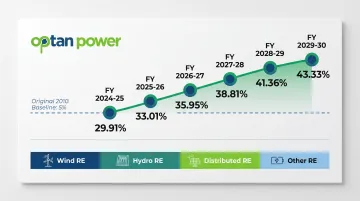
Year-wise RPO Targets (FY 2024-25 through 2029-30)
| FY | Wind RE | Hydro RE | Distributed RE (<10 MW) | Other RE | Total RE |
|----|---------|----------|------------------------|----------|--------------|
| 2024-25 | 0.67% | 0.38% | 1.50% | 27.35% | 29.91% |
| 2025-26 | 1.45% | 1.22% | 2.10% | 28.24% | 33.01% |
| 2026-27 | 1.97% | 1.34% | 2.70% | 29.94% | 35.95% |
| 2027-28 | 2.45% | 1.42% | 3.30% | 31.64% | 38.81% |
| 2028-29 | 2.95% | 1.42% | 3.90% | 33.10% | 41.36% |
| 2029-30 | 3.48% | 1.33% | 4.50% | 34.02% | 43.33% |
"Other RE" — which includes biomass, bagasse, municipal solid waste, and all RE projects commissioned before April 1, 2024 — dominates the obligation at 27-34% throughout the period. The newer sub-categories (Wind RE, Hydro RE, Distributed RE) are the incremental growth drivers, collectively rising from 2.55% to 9.31%.
The graduated ramp-up gives stakeholders time to adjust procurement strategies, sign PPAs, or install captive capacity. The trajectory is still demanding: total RPO has quadrupled from the original 2010 baseline of 5%.
Energy Storage Obligation (ESO) Trajectory
| FY | ESO (%) |
|---|---|
| 2024-25 | 1.0% |
| 2025-26 | 1.5% |
| 2026-27 | 2.0% |
| 2027-28 | 2.5% |
| 2028-29 | 3.0% |
| 2029-30 | 3.5% |
ESO is fulfilled only when at least 85% of total energy stored in the energy storage system (ESS) on an annual basis is procured from renewable sources. The ESS definition covers electrical energy storage including pumped storage, provided the storage uses renewable energy.
This obligation addresses grid stability requirements as variable RE sources (solar, wind) scale up. C&I consumers must now plan for both generation procurement and storage capacity. Long-term PPAs with integrated battery energy storage systems (BESS) are becoming the practical mechanism for meeting both obligations simultaneously.
Hydro Renewable Obligation (HRO)
The HRO applies to energy from hydroelectric projects (including pumped storage and small hydro) commissioned after March 31, 2024. This first-ever hydro sub-obligation recognizes new capacity additions and distinguishes them from legacy hydro projects, which fall within the "Other RE" category.
Meeting all these sub-obligations in every compliance year isn't always feasible. GERC's carry-forward mechanism provides a structured relief path for entities facing verified market constraints.
Carry-Forward Mechanism
Under Regulation 10(2), entities facing "genuine difficulty" due to insufficient REC supply may apply to GERC for permission to carry forward the unmet obligation to the next compliance period. If GERC consents, penalty provisions under Section 142 of the Electricity Act are not invoked.
Precedent: Reliance Industries Limited filed Petition 2160 of 2022 (dated December 17, 2022) seeking carry-forward of FY 2021-22 RPO compliance due to the APTEL stay on REC trading from July 24, 2020 to November 9, 2021. The petition was admitted on May 30, 2023. Similarly, ONGC petitions (1933/2021, 1892/2020) demonstrate that even large PSUs face compliance challenges and utilize the carry-forward mechanism.
One caveat to note: GERC reserves the right to levy penalties even when carry-forward is granted, so entities must document genuine market constraints and apply proactively.
Compliance Pathways: RECs, PPAs, and Open Access in Gujarat
Obligated entities have three primary compliance pathways, which can be combined strategically:
Pathway 1: Physical RE Procurement (PPAs and Captive)
Entities can meet RPO by directly installing captive renewable energy plants or entering into Power Purchase Agreements (PPAs) with RE generators in Gujarat or through interstate transmission. PPAs executed on or after January 18, 2010 are eligible for RPO accounting.
No double-counting rule: The same unit of energy cannot simultaneously count for both RPO compliance and REC issuance. RE generators selling power to a DISCOM under a PPA (other than REC mechanism) are not eligible for REC accreditation for that same energy, as the DISCOM uses it to offset its own RPO.
Pathway 2: Renewable Energy Certificates (RECs)
CERC oversees the national REC mechanism; GEDA serves as Gujarat's state-level nodal agency. Obligated entities that cannot source sufficient RE physically can purchase RECs on power exchanges to fulfill their RPO.
Recent REC framework changes (CERC Regulations 2022):
| Feature | Current Status |
|---|---|
| REC Validity | Perpetual — valid until redeemed (previously 1,095 days) |
| Floor/Forbearance Price | Eliminated — market-discovered pricing only |
| Solar/Non-Solar Distinction | Removed — single "REC" contract with technology multipliers |
| Certificate Multipliers | Onshore Wind/Solar: 1.0; Hydro: 1.5; Biomass/Biofuel: 2.5 |
| Trading Platforms | IEX, PXIL, HPX (Hindustan Power Exchange) |
| Bilateral Trades | Now permitted via Trading Licensees |
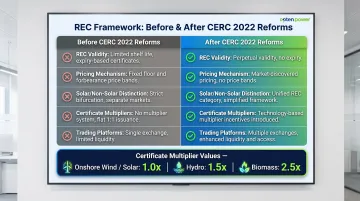
These reforms improve REC liquidity and eliminate expiry risk, allowing entities to bank certificates without time pressure.
Pathway 3: Green Open Access
The GERC (Terms and Conditions for Green Energy Open Access) Regulations, 2024 (Notification No. 08 of 2024, dated February 21, 2024) establish the framework for eligible consumers to purchase RE power directly from generators or traders using the grid.
Eligibility: 100 kW minimum threshold (single connection or aggregated connections within the same electricity division), which is significantly lower than the 1 MW threshold for conventional open access.
Applicable charges:
- Inter-state and intra-state transmission charges
- Wheeling charges
- Cross-Subsidy Surcharge (CSS)
- Additional Surcharge
- Standby charges (where applicable)
- Banking charges (extended at ₹1.50/kWh until June 2026)
- SLDC fees, scheduling charges, DSM charges
Key advantage: Green energy open access consumers have priority over conventional open access consumers in the same category. Captive consumers are eligible for CSS exemption, making group captive/third-party open access structures economically attractive even at relatively small scales.
For reference, CSS rates for FY 2026-27 in one Gujarat licensee's jurisdiction range from ₹0.58/kWh (HTP-III at 11 kV) to ₹1.48/kWh (HTP-I at 11 kV), with wheeling charges around ₹0.54/unit. Rates vary by DISCOM and voltage level.
Cross-Category Flexibility (Regulation 4)
The 2025 framework allows strategic offset flexibility:
- Shortfall in Wind RE can be met by excess Hydro RE and vice-versa
- Excess Wind or Hydro RE can be used to meet "Other RE" targets
- Excess "Other RE" can meet shortfalls in Wind or Hydro RE
- REC multipliers approved by CERC allow cross-category certificate purchases
This flexibility reduces compliance burden for entities with concentrated RE procurement in one source type, which is particularly relevant for Gujarat where wind and solar dominate.
Opten Power's Role in Accelerating Compliance
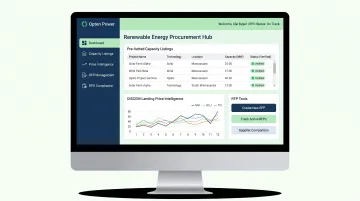
Balancing these three pathways — physical PPAs, RECs, and open access — while tracking CSS rates, cross-category offsets, and charge structures across multiple DISCOMs is operationally complex. That's where Opten Power helps C&I buyers shorten the path from decision to contract.
Key capabilities relevant to Gujarat compliance:
- Access to 4+ GW of pre-vetted solar, wind, and hybrid capacity across 16 states
- Real-time DISCOM landing price intelligence covering transmission, wheeling, CSS, and other open access charges for accurate total cost comparison
- Automated RFP tools and pre-approved contract templates that reduce deal timelines by up to 50%
- Instant IRR and payback analysis grounded in actual cost data, supporting compliance planning against escalating RPO and ESO targets
Penalties, Reporting Framework, and How to Stay Compliant
Penalty Structure
Entities that fail to meet RPO targets face a penalty of ₹3.72 per kWh of unmet obligation, derived using the tonne of oil equivalent (TOE) value under the Energy Conservation Act, 2001:
- 1 TOE = 11,630 kWh
- Value of 1 TOE = ₹21,650 (per Ministry of Power Notification dated December 26, 2023)
- Penalty = (2 x ₹21,650) / 11,630 = ₹3.72 per kWh
The penalty amount is deposited into a dedicated fund maintained by the obligated entity or State Agency (GEDA). The fund finances REC purchases and transmission/sub-transmission infrastructure for RE evacuation, giving penalties both a deterrent and a reinvestment purpose.
With current market REC prices well below ₹3.72 per certificate, buying RECs to cover shortfalls is almost always cheaper than paying the penalty.
Compliance Reporting System
All obligated entities must submit renewable energy usage, REC purchase records, and compliance status data through the online RPPO web portal maintained by GEDA:
| Entity Size | Filing Requirement | Deadline |
|---|---|---|
| Above 1 MW | File petition directly with GERC | June 30 each year |
| Below 1 MW | Submit report to GEDA | June 30 each year |
GEDA consolidates sub-1 MW reports into a collective petition. All data is made publicly accessible, creating peer visibility and reputational accountability.
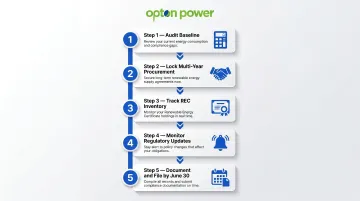
Practical Steps to Stay Compliant
1. Audit your baseline (Q1 of each fiscal year)
- Calculate actual conventional energy consumption
- Determine category-wise RPO obligation (Wind RE, Hydro RE, Distributed RE, Other RE)
- Calculate ESO requirement separately
2. Lock in multi-year procurement before Q3
- Sign PPAs or open access agreements well before year-end to avoid spot REC price spikes
- Consider group captive structures for CSS exemption benefits
- Evaluate cross-category flexibility to reduce compliance costs
3. Track REC inventory and purchase timing
- RECs trade in real-time on IEX, PXIL, and HPX
- Bank certificates when prices are low — perpetual validity makes this risk-free
- Monitor certificate multipliers (Hydro: 1.5x; Biomass: 2.5x) for strategic purchases
4. Monitor regulatory updates quarterly
- Check GERC orders and GEDA circulars for changes to RPO percentages or compliance guidelines
- Subscribe to GERC's public notice mailing list
- Track tariff order publications for CSS and wheeling charge updates
5. Document everything and file on time
- Maintain certified records of all RE procurement, whether physical or via RECs
- Ensure no double-counting between RPO credit and REC issuance
- File petitions/reports by June 30 to avoid additional penalties
Frequently Asked Questions
What is green open access (open access regulation)?
Green open access allows eligible consumers (above 100 kW threshold in Gujarat) to buy renewable energy directly from generators using the grid, bypassing the distribution licensee's standard supply. Under GERC's 2024 framework, it is a key route for large C&I consumers to procure RE at competitive rates while earning RPO compliance credit.
What is the surcharge for open access electricity in Gujarat and how are open access charges calculated?
Open access in Gujarat involves transmission charges, wheeling charges, scheduling charges, and Cross-Subsidy Surcharge (CSS). CSS is the largest variable cost, set by GERC in annual tariff orders, ranging from ₹0.58/kWh to ₹1.48/kWh by consumer category and voltage level. Captive consumers may qualify for CSS exemption.
What is Gujarat's solar subsidy and renewable energy policy, including the 2026 scheme?
Gujarat's Surya Gujarat (PM Surya Ghar) rooftop solar scheme provides capital subsidies for residential and MSME installations, backed by net metering — Gujarat leads India with 3.36 lakh systems and 5,317 MW installed. For current subsidy amounts and 2025-2026 updates, consult GEDA's official portal or the PM Surya Ghar Muft Bijli Yojana website.
What is the penalty for non-compliance with RPO targets under GERC regulations?
GERC levies a penalty of ₹3.72 per kWh of unmet RPO obligation under the Energy Conservation Act, 2001 (calculated using TOE value of ₹21,650). Collected penalties are deposited into a dedicated fund used to purchase RECs and develop RE infrastructure in Gujarat.
Can open access renewable energy purchases be counted towards RPO compliance under GERC?
Yes, RE energy purchased through open access (either directly from generators or via traders) qualifies for RPO compliance credit under GERC regulations, provided the purchase is documented with valid contracts or invoices. However, the same energy unit cannot simultaneously be used for both RPO compliance and REC issuance — entities must choose one compliance route per unit.
What is the Energy Storage Obligation (ESO) under GERC's 2025 regulations?
The ESO requires obligated entities to maintain energy storage capacity equal to a set percentage of total consumption, starting at 1% in FY 2024-25 and rising to 3.5% by FY 2029-30, with at least 85% of stored energy sourced from renewables. Introduced to support grid stability as RE penetration grows, ESO targets are separate from — and additive to — existing RPO obligations.