Introduction
For most Indian commercial and industrial businesses, electricity is both a major operating cost and an uncontrollable one. State distribution companies (DISCOMs) typically charge C&I consumers between ₹6 to ₹8 per unit — and those rates keep climbing, with no long-term cost certainty.
Solar Power Purchase Agreements (PPAs) directly address this. They lock in energy rates for 15–25 years, delivering immediate savings without any capital outlay from the buyer.
Yet as more C&I businesses explore PPAs, one term appears repeatedly without clear explanation: the offtaker. Understanding this role is essential because the offtaker isn't just a participant in the deal — they're the financial anchor that makes or breaks project financing.
This article explains what an offtaker is, where they fit in the PPA structure, why their financial strength is scrutinized so carefully, and what obligations and benefits come with entering a solar PPA.
Key Takeaways
- An offtaker is the buyer who commits to purchasing solar energy under a long-term contract of 15–25 years
- The offtaker's creditworthiness directly determines whether lenders will finance the project
- Offtakers are typically C&I buyers — manufacturers, data centres, hospitals, and other high-load consumers with predictable energy demand
- Locking in below-grid tariff rates protects against rising DISCOM costs and supports RPO compliance
The Three Parties in a Solar PPA: Setting the Context
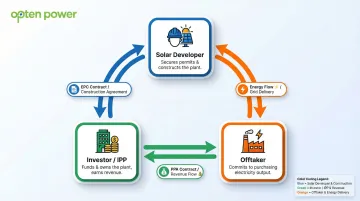
A solar PPA is built on three distinct roles. Each party carries specific obligations — and the deal only closes when all three align.
1. The Solar Developer secures permits, manages project design and construction, and brings the asset from concept to commercial operation. Developers typically either hand the built plant to an investor or continue as the operator.
2. The Investor or Independent Power Producer (IPP) funds and owns the solar plant, earning long-term revenue from electricity sales along with benefits such as accelerated depreciation. Their willingness to invest hinges almost entirely on the offtaker's creditworthiness and contractual commitment.
3. The Offtaker commits to purchasing the plant's output at a pre-agreed price over a defined contract period. They don't own the asset — they agree to buy what it produces, and that commitment is what makes the project bankable.
Without a creditworthy offtaker, most solar projects cannot raise debt or attract institutional investment — which is why understanding who qualifies as an offtaker matters before structuring any deal.
What Is a Solar PPA Offtaker?
Core Definition
The offtaker is the purchaser of the electricity generated by a solar project under a Power Purchase Agreement. The offtaker does not own the solar plant — they agree to buy the power it produces at a pre-agreed price (per kWh or kVAh) over a contract period, typically 15–25 years.
The core mechanism is straightforward: the offtaker pays a fixed or escalated tariff for energy consumed, typically 20–40% below the prevailing DISCOM tariff — locking in cost savings for the contract's full duration.
Physical vs. Virtual Offtakers
How an offtaker actually receives — or settles for — that electricity depends on the structure of the PPA.
Physical offtakers receive actual electricity — either via a dedicated direct line or through the state grid under open access. Grid delivery involves additional charges:
- Wheeling charges
- Transmission charges
- Cross-subsidy surcharges
These costs reduce but don't eliminate the savings advantage over standard DISCOM tariffs.
Virtual (financial) offtakers skip physical delivery entirely. The generator sells power on the exchange; the offtaker and generator then settle the difference between the agreed strike price and the market settlement price. CERC's December 2025 guidelines formally recognized Virtual PPAs (VPPAs) in India, making this structure increasingly viable for C&I buyers with complex grid arrangements.
Why Offtakers Matter to Project Finance
The offtaker's commitment is what makes a solar project financeable. Lenders need predictable revenue; the signed PPA provides it.
Without a creditworthy offtaker, projects struggle to raise debt or attract institutional investment from banks and NBFCs. Lenders scrutinize the offtaker's financial health closely — their ability to pay reliably for 15–25 years determines whether the project gets funded at all, and on what terms.
Who Can Be a Solar PPA Offtaker?
Not every business qualifies as a solar PPA offtaker. The key qualifier is having large, stable, and consistent energy demand — typically measured in hundreds of kilowatts to tens of megawatts — that justifies a long-term commitment.
Most offtakers fall into one of four broad categories:
Main Categories of Offtakers in India
- Large Industrial Consumers — Steel, cement, textiles, and fertiliser manufacturers; process industries with continuous 24x7 operations; manufacturing units with predictable load profiles
- Commercial Establishments — IT parks, data centres, hotels, hospitals, warehouses, logistics centres, and commercial office complexes
- Institutional Buyers — Universities, educational campuses, municipalities, and government facilities
- Utilities — State-owned DISCOMs or electricity utilities in utility-scale projects, purchasing power for distribution to end consumers
Threshold Requirements
Smaller consumers rarely qualify for direct bilateral PPAs. Typical minimum demand thresholds start around 500 kW, though this varies by developer and project size. Smaller businesses may participate through group captive or aggregated structures, pooling demand to meet minimum project thresholds.
Why Offtaker Creditworthiness Is Non-Negotiable
The Single Most Scrutinized Factor
Lenders and investors need confidence that an offtaker can pay for electricity over 15–25 years. Without that confidence, a project simply cannot be financed on reasonable terms — no matter how strong the solar resource or the developer's track record.
The Credit Spectrum
Large conglomerates, multinationals, and listed companies with strong balance sheets make near-ideal partners. They typically hold investment-grade ratings (A to BBB) and can access financing with minimal additional security.
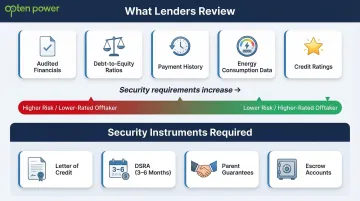
Private SMEs, NGOs, and municipal bodies without formal credit ratings sit at the other end. These offtakers usually require additional security structures before a project can proceed:
- Letter of Credit (LC) equivalent to one month's billing
- Debt Service Reserve Accounts (DSRA) covering 3-6 months of payments
- Parent company guarantees
- Escrow accounts with priority access for lenders
What Credit Analysis Looks Like
Lenders typically review:
- Audited financial statements (3-5 years)
- Debt-to-equity ratios and liquidity metrics
- Payment history with existing creditors
- Energy consumption data (to verify load stability)
- Credit ratings (if available)
For unrated offtakers, lenders may require letters of credit, payment guarantees, or personal guarantees from promoters. The more gaps in the credit picture, the more security instruments a developer needs to stack — which directly affects project economics and deal timelines.
The Risk of Offtaker Default
If an offtaker defaults mid-contract, the project loses its revenue stream, potentially triggering loan defaults. This risk shapes PPA terms:
- Penalty clauses for payment delays
- Termination provisions with liquidated damages
- Security deposit requirements (typically 1-2 months of billing)
- Escrow routing to ensure lenders get paid first
In India's growing C&I solar PPA market, finding bankable offtakers is often the biggest bottleneck for project developers. Opten Power pre-qualifies offtakers before they enter the deal pipeline, matching them with developers across 16 states so both sides reach the table with verified financials already in hand.
What Are the Key Obligations of an Offtaker Under a Solar PPA?
Payment Terms and Minimum Offtake Commitments
The offtaker must pay the agreed tariff per unit of electricity consumed or generated, on schedule and for the full contract duration. Even in months when consumption falls, minimum offtake clauses may require partial payment. Many PPAs include "deemed generation" clauses — if the offtaker's facility cannot receive power due to internal outages or roof repairs, they must still pay based on historical average generation.
Site Access and Day-to-Day Coordination
For on-site or rooftop PPAs, the offtaker must:
- Allow site access for installation and maintenance
- Maintain the point of interconnection
- Ensure roof structural integrity (for rooftop systems)
- Not interfere with plant operations or grid connection
- Coordinate factory maintenance schedules to avoid overlap with peak generation periods
Risks the Offtaker Carries
The offtaker bears certain risks that are negotiated and spelled out in the PPA:
- Fluctuations in their own energy consumption
- Changes in open access regulations (policy risk is real in India)
- Force majeure situations affecting their ability to receive power
- Grid unavailability or DISCOM-side interruptions (depending on contract structure)
Termination and Exit Provisions
Exiting a PPA before the contract term is expensive. Termination clauses typically require the offtaker to pay liquidated damages covering the present value of lost future revenues. Many contracts impose damages equivalent to 6 months of capacity charges, or charges for the remaining PPA term, whichever is lower — though exact terms vary by developer and project structure.
Disputes are typically resolved through arbitration or before state/central electricity regulatory commissions under India's Electricity Act, 2003. Reading these clauses carefully before execution is non-negotiable.
Benefits of Entering a Solar PPA as an Offtaker
Cost Savings Without Capital Expenditure
The offtaker gets access to solar power at a tariff typically 20–40% below the prevailing grid rate, with no upfront investment in solar infrastructure. The developer/IPP handles all capital expenditure, installation, and operations and maintenance.
For C&I buyers evaluating multiple developers, platforms like Opten Power provide real-time tariff comparisons, savings projections, and IRR analysis — along with payback period and regulatory impact assessments across 16 states — before any commitment is made.
Long-Term Price Predictability
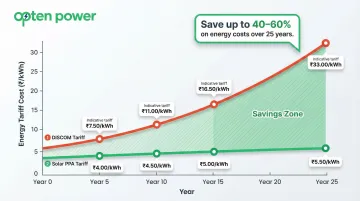
Unlike fluctuating DISCOM tariffs that have historically risen, a solar PPA locks in a fixed or mildly escalating tariff for 15–25 years. This enables accurate energy cost forecasting for budgeting and operations, protecting businesses from future rate hikes that typically range from 3-7% annually.
Sustainability and Regulatory Compliance
Entering a solar PPA helps large energy consumers:
- Meet India's Renewable Purchase Obligation (RPO) targets, which mandate 43.33% renewable energy sourcing by FY2029-30
- Reduce Scope 2 emissions under the GHG Protocol's market-based method
- Strengthen ESG reporting for SEBI BRSR compliance — increasingly important for listed companies, export-oriented industries, and institutions with sustainability mandates
Renewable Energy Certificates (RECs) transferred through the PPA create a verifiable audit trail for corporate decarbonization claims, helping businesses avoid regulatory penalties under Section 26(3) of the Energy Conservation Act 2001.
Frequently Asked Questions
What is a PPA offtaker?
A PPA offtaker is the buyer of electricity in a Power Purchase Agreement, the entity that commits to purchasing electricity generated by a solar (or other renewable) project at an agreed price over a fixed term, without owning the asset.
How does a PPA agreement work?
A PPA is a contract where a solar developer or IPP builds and operates a plant, and the offtaker agrees to purchase the electricity produced at a pre-agreed tariff for a set period (typically 15–25 years). This provides revenue certainty for the generator and cost predictability for the buyer.
What is the purpose of an offtake agreement?
The offtake agreement secures a long-term buyer for the project's electricity output, giving lenders and investors the revenue certainty they need to finance construction — without one, most solar projects cannot access debt or equity.
Is a PPA the same as an offtake agreement?
In the renewable energy context, a PPA is a specific type of offtake agreement. Both refer to contracts that secure power sale and purchase, but "offtake agreement" is the broader term used across commodities, while "PPA" applies specifically to electricity procurement.
Is a PPA a hedge?
Yes. For the offtaker, a PPA locks in a fixed tariff rate, hedging against rising electricity costs. For the generator, it hedges against wholesale market price volatility.
What are different types of PPA?
In the Indian market, the main types are open access PPAs (off-site supply via the grid), group captive PPAs (where the offtaker holds an equity stake in the project), and on-site/rooftop PPAs (direct supply at the premises). Virtual or financial PPAs exist globally but are rarely used in India's current regulatory framework. Each structure carries different ownership, tariff, and compliance requirements.